 1 / 11
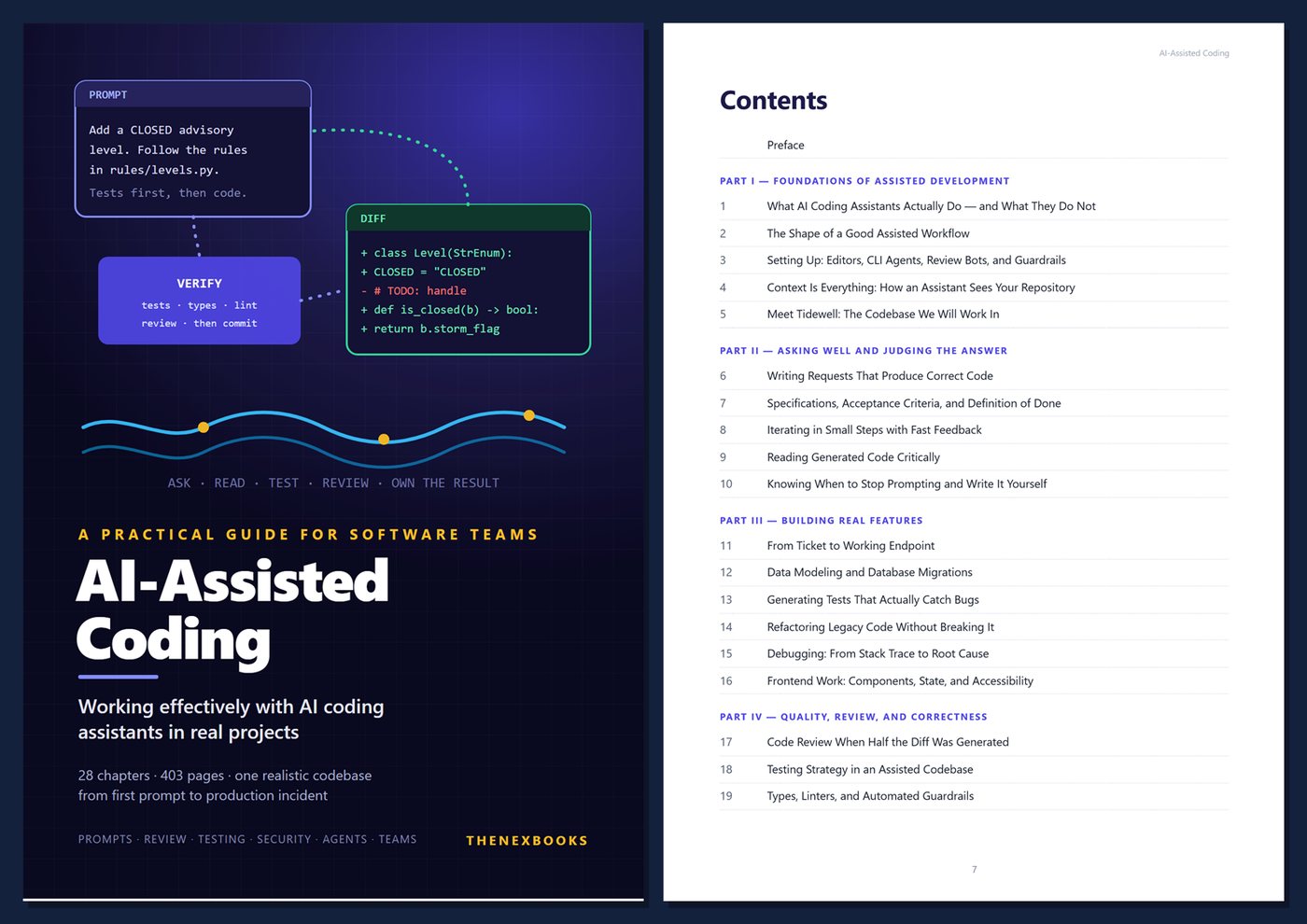
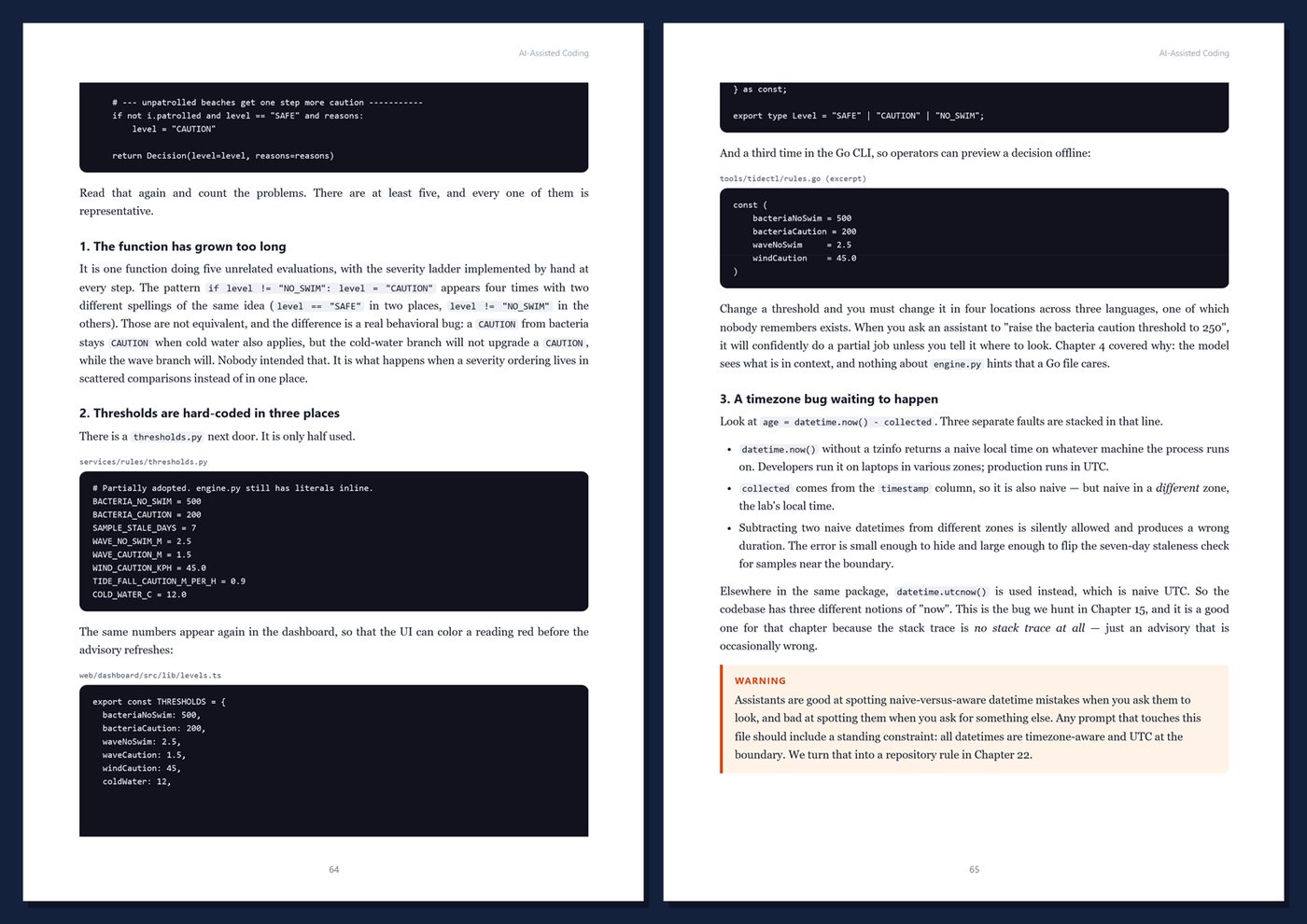
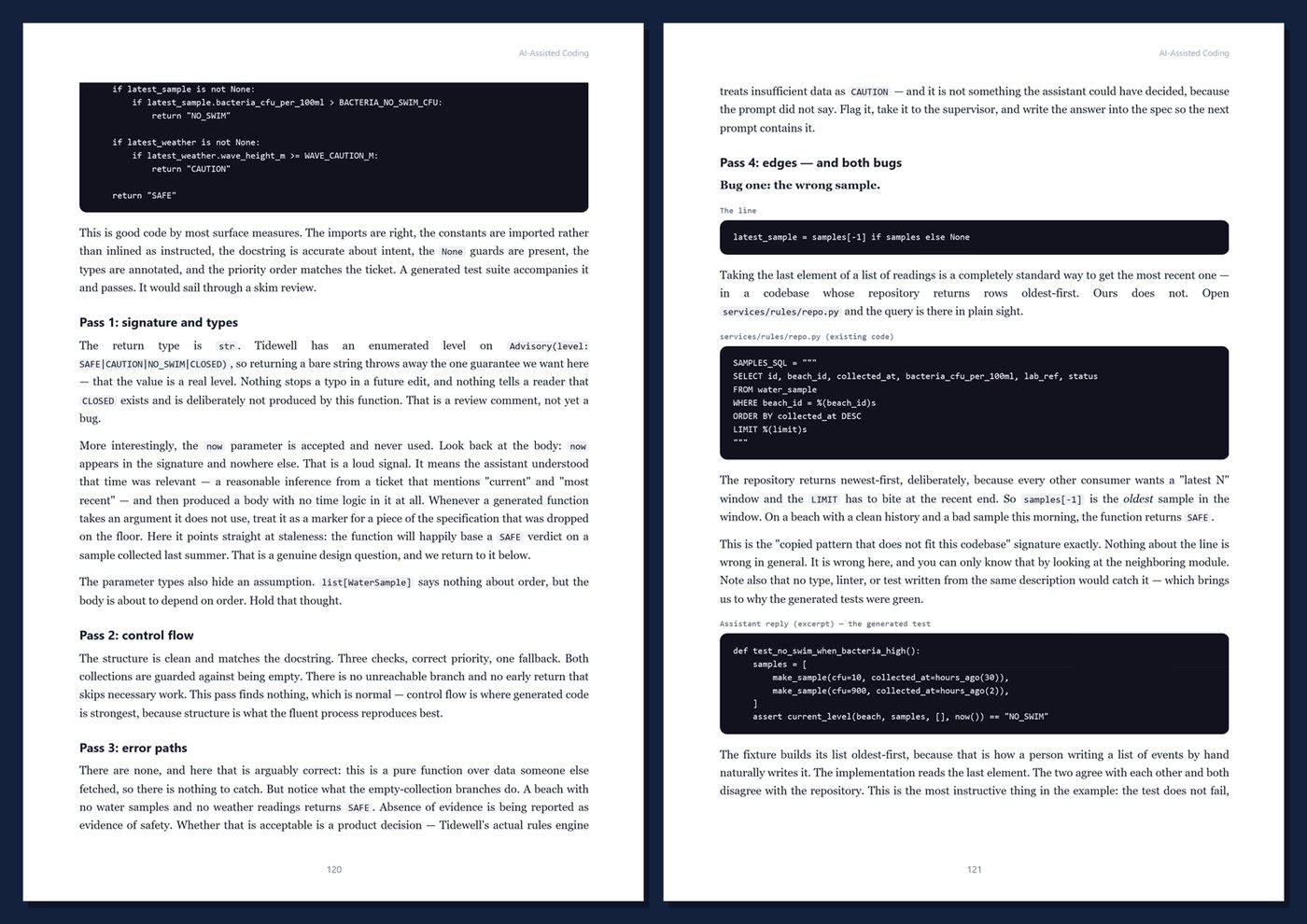
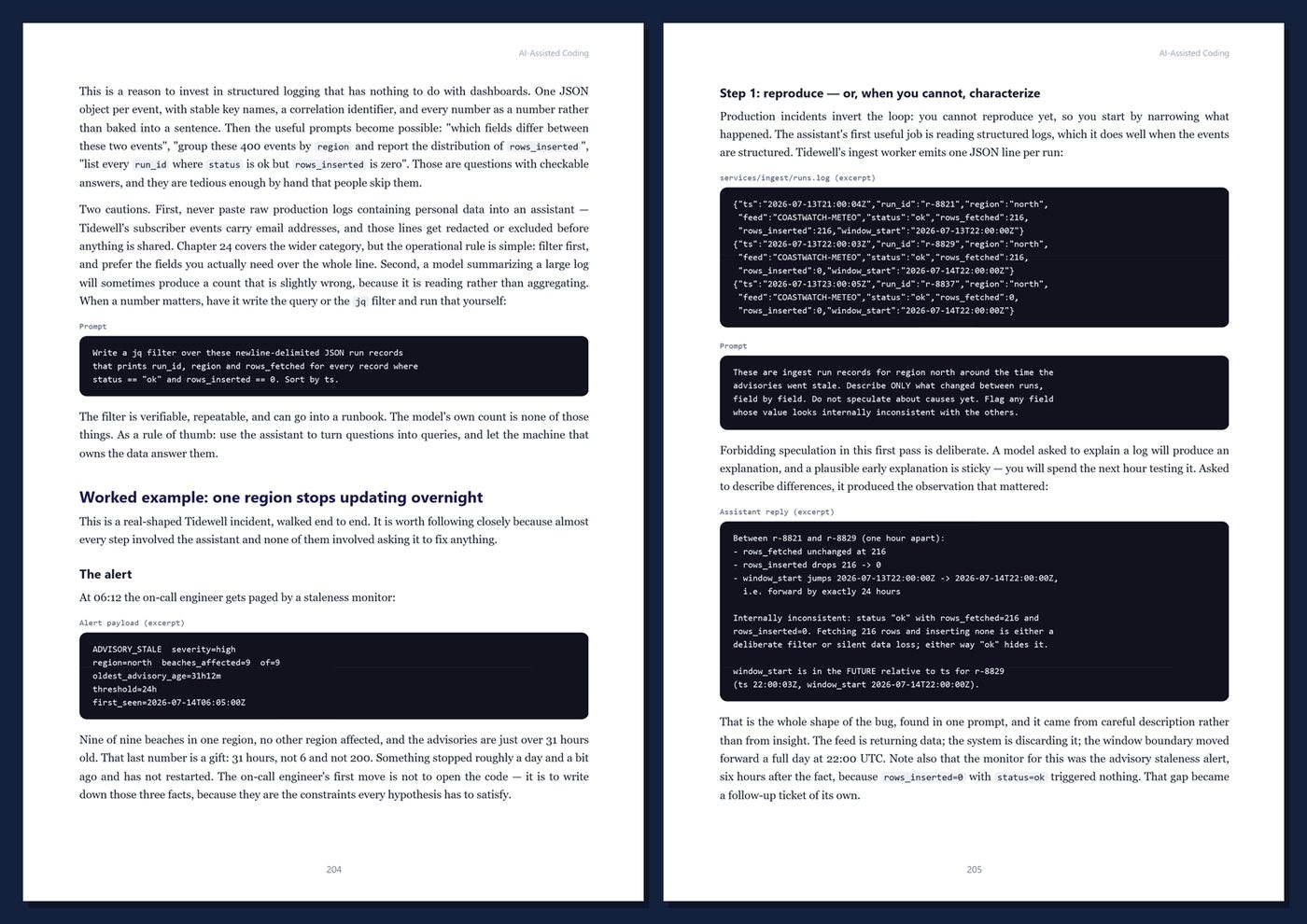
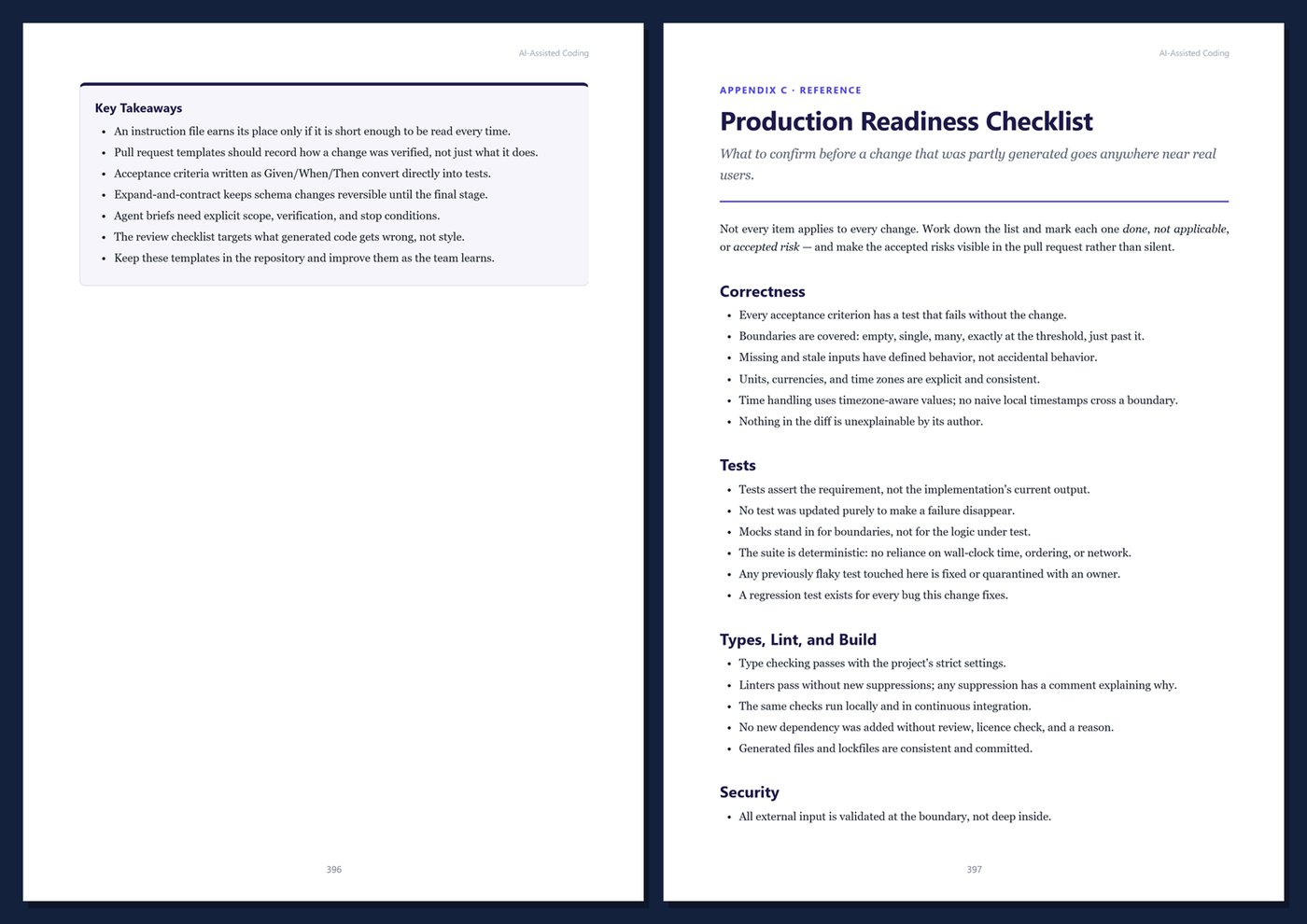
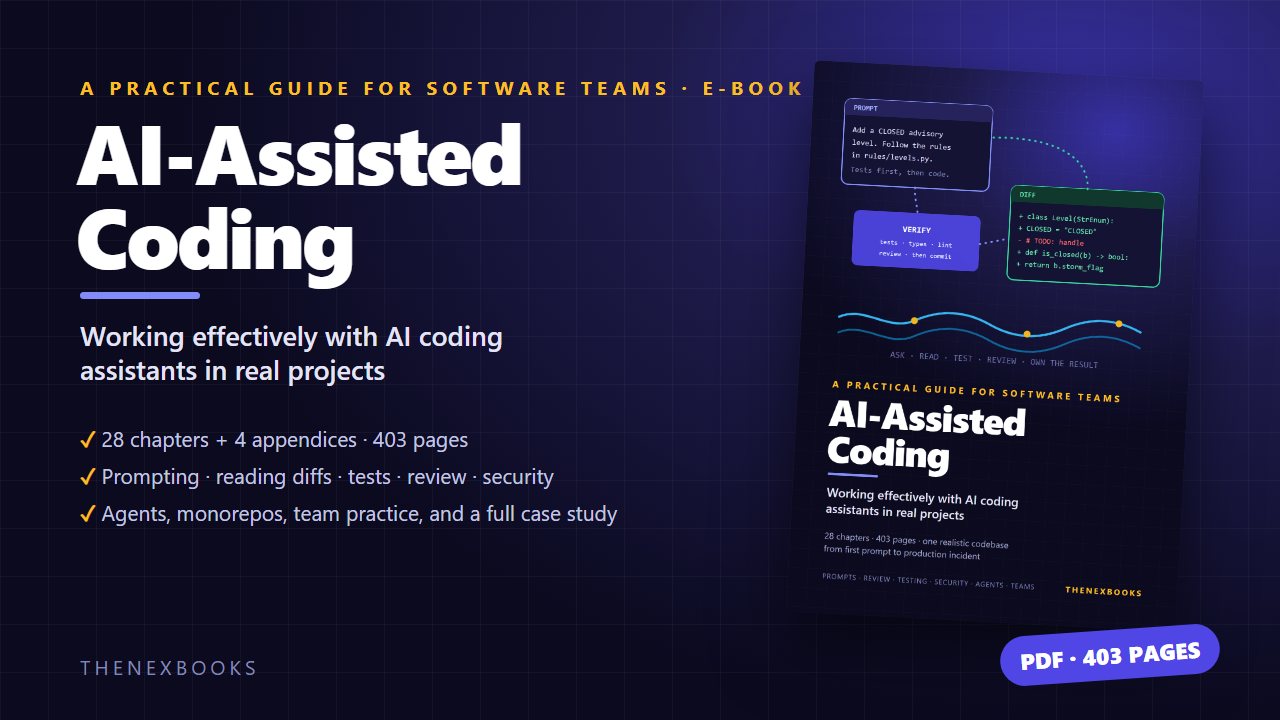
A 403-page practical guide to working with AI coding assistants on real codebases — prompting, reviewing, testing, securing, and shipping code you are still responsible for.
Working Effectively with AI Coding Assistants in Real Projects
Read before you buy: the PDF here is a free sample — the first 20 pages of the 403-page book (payments, sales and reviews on this demo site are sample data). Get the full e-book at thenexbooks on Gumroad.
Your assistant writes the function in four seconds. Deciding whether to ship it is still your job.
That gap is what this book is about. Generated code is your code the moment you commit it, and the skills that matter now are not tricks for getting longer completions — they are framing a request precisely, reading a diff critically, testing what actually matters, reviewing work you did not type, and knowing when to stop asking and write it yourself.
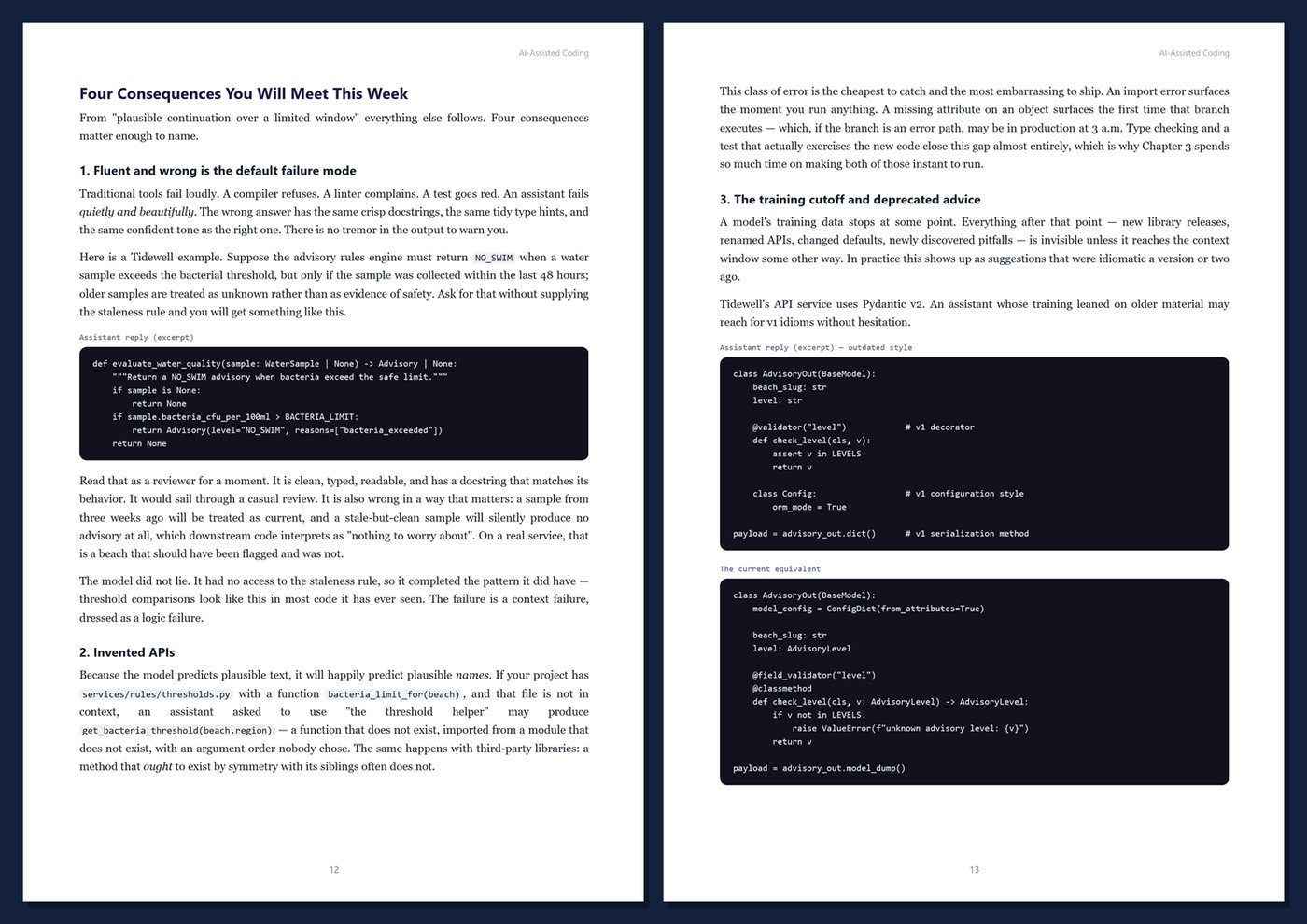
This is a practical manual for professional developers, written around one realistic codebase: Tidewell, a coastal water-safety advisory service with a Python API, an ingest worker, a rules engine, a TypeScript dashboard, SQL migrations, and genuine technical debt. Every technique is applied to real work — an endpoint from ticket to merge, a zero-downtime migration, a legacy refactor, a production incident at 3 a.m. — not to toy examples.
- 403 pages · 28 chapters + 4 appendices
- A working mental model: why assistants fail the way they do, and where their leverage is real
- Request patterns that produce correct code, and specifications that can actually be verified
- Reading generated code critically — the bugs that look like good code
- Six complete features: endpoint, migration, tests, refactor, debugging, frontend
- Code review when half the diff was generated, and testing strategy that is not just volume
- Types, linters, and guardrails that constrain an assistant better than any prompt
- Security review: injection, authorization gaps, secrets, SSRF, and prompt injection
- Team practice: instruction files, shared prompts, onboarding, and keeping knowledge in the team
- Licensing, IP, privacy, and compliance — the questions to ask early
- Agents and CI automation, monorepos, and long-lived migrations
- No vendor hype and no invented productivity statistics — Chapter 25 shows you how to measure your own team
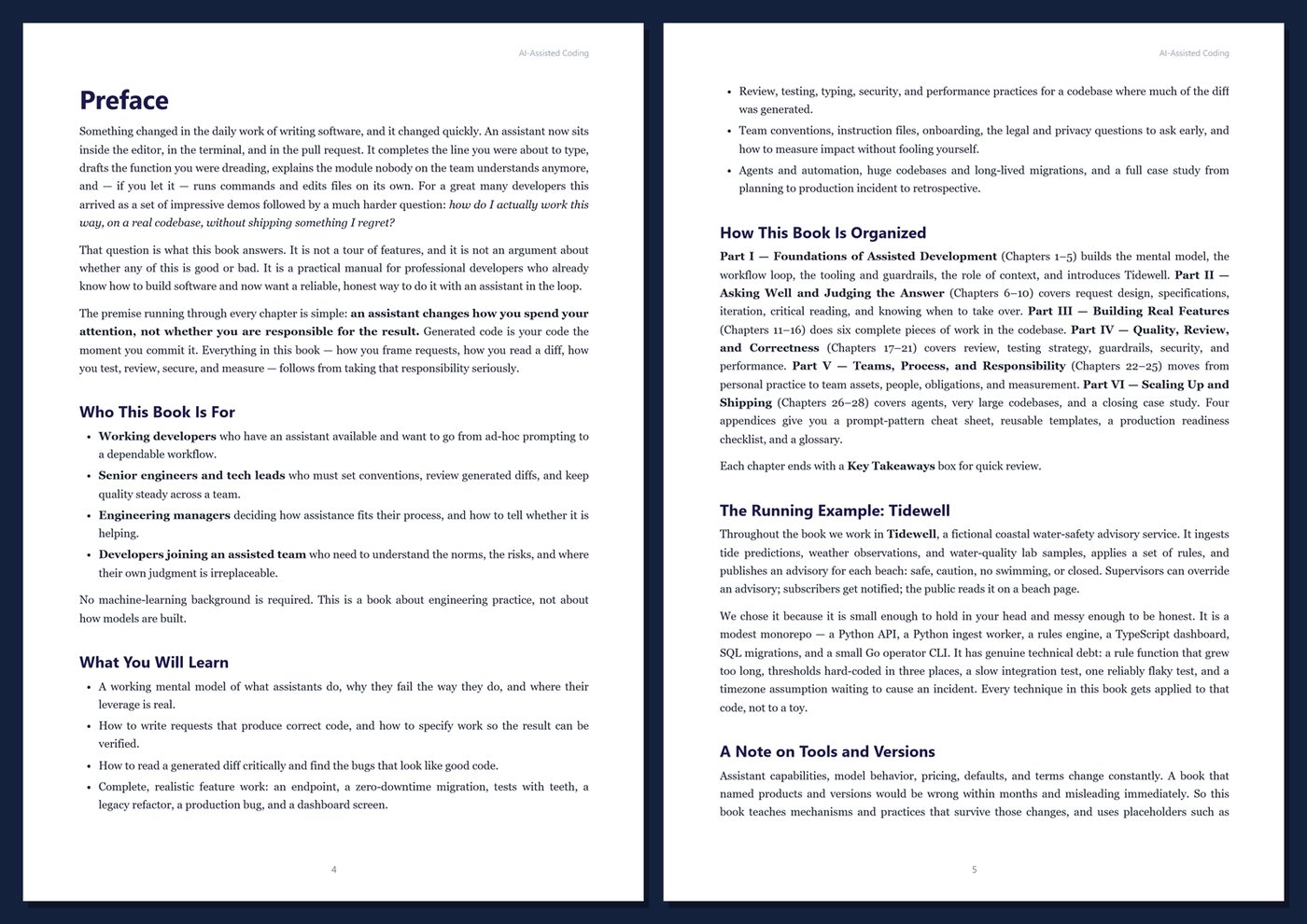
Table Of Contents
Part I — Foundations of Assisted Development
- Ch 1 · What AI Coding Assistants Actually Do — and What They Do Not
- Ch 2 · The Shape of a Good Assisted Workflow
- Ch 3 · Setting Up: Editors, CLI Agents, Review Bots, and Guardrails
- Ch 4 · Context Is Everything: How an Assistant Sees Your Repository
- Ch 5 · Meet Tidewell: The Codebase We Will Work In
Part II — Asking Well and Judging the Answer
- Ch 6 · Writing Requests That Produce Correct Code
- Ch 7 · Specifications, Acceptance Criteria, and Definition of Done
- Ch 8 · Iterating in Small Steps with Fast Feedback
- Ch 9 · Reading Generated Code Critically
- Ch 10 · Knowing When to Stop Prompting and Write It Yourself
Part III — Building Real Features
- Ch 11 · From Ticket to Working Endpoint
- Ch 12 · Data Modeling and Database Migrations
- Ch 13 · Generating Tests That Actually Catch Bugs
- Ch 14 · Refactoring Legacy Code Without Breaking It
- Ch 15 · Debugging: From Stack Trace to Root Cause
- Ch 16 · Frontend Work: Components, State, and Accessibility
Part IV — Quality, Review, and Correctness
- Ch 17 · Code Review When Half the Diff Was Generated
- Ch 18 · Testing Strategy in an Assisted Codebase
- Ch 19 · Types, Linters, and Automated Guardrails
- Ch 20 · Security Review of Generated Code
- Ch 21 · Performance Work: Measure First, Then Ask
Part V — Teams, Process, and Responsibility
- Ch 22 · Team Conventions: Instruction Files, Rules, and Shared Prompts
- Ch 23 · Onboarding, Pairing, and Keeping Knowledge in the Team
- Ch 24 · Licensing, Intellectual Property, Privacy, and Compliance
- Ch 25 · Measuring Impact Without Fooling Yourself
Part VI — Scaling Up and Shipping
- Ch 26 · Agents: Multi-Step Tasks, Tools, and Automation in CI
- Ch 27 · Large Codebases, Monorepos, and Long-Lived Migrations
- Ch 28 · Case Study: Shipping Tidewell v2 with an Assisted Team
Appendices
- App A · Prompt Patterns Cheat Sheet
- App B · Templates and Reference
- App C · Production Readiness Checklist
- App D · Glossary
WHO IT IS FOR
Working developers who want to go from ad-hoc prompting to a dependable workflow, senior engineers and tech leads who must review generated diffs and set team conventions, engineering managers deciding how assistance fits their process, and developers joining an assisted team who need to know where their own judgment is irreplaceable. No machine-learning background required.
FORMAT
PDF (A4), 403 pages, English, clickable table of contents and PDF bookmarks. 1st Edition, 2026. Published by thenexbooks.
A NOTE ON TOOLS
This book deliberately does not name assistant products or model versions. Their capabilities, defaults, and terms change faster than any book can track, so it teaches mechanisms and practices that survive those changes and uses placeholders where a product name would otherwise appear. Chapter 24 discusses licensing, IP, and privacy in general terms only and is not legal advice.
This book is independent and is not affiliated with or endorsed by any tool vendor, model provider, or platform.
Book details
| Detail | |
|---|---|
| Pages | 403 |
| Format | PDF (A4) |
| Language | English |
| Level | Intermediate to Advanced |
| Edition | 1st Edition, 2026 |
| Download on this site | Free sample, first 20 pages (PDF) |
| Publisher | thenexbooks |
Files you get
No reviews yet. Only buyers can review.
More from thenexbooks