 1 / 11
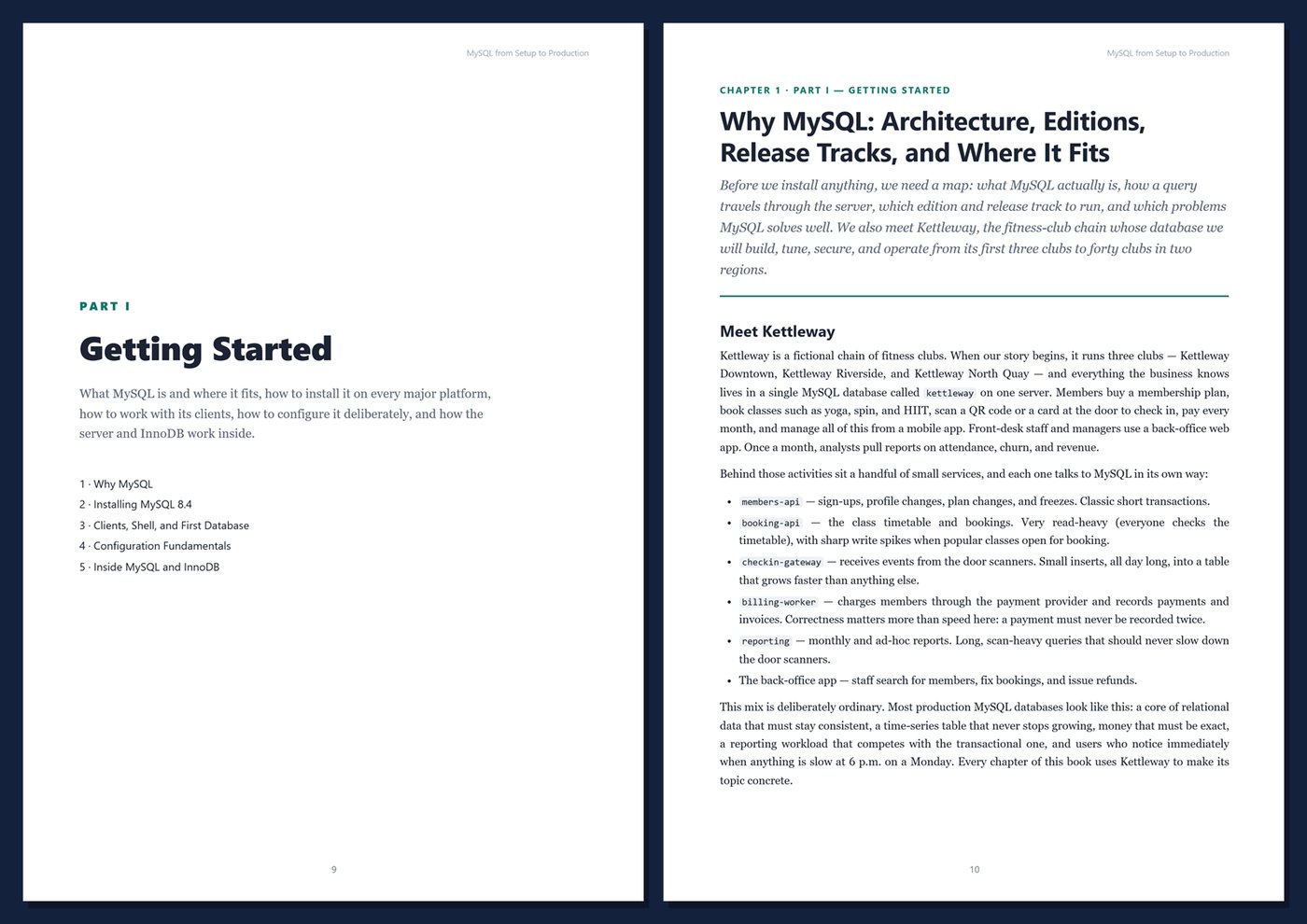
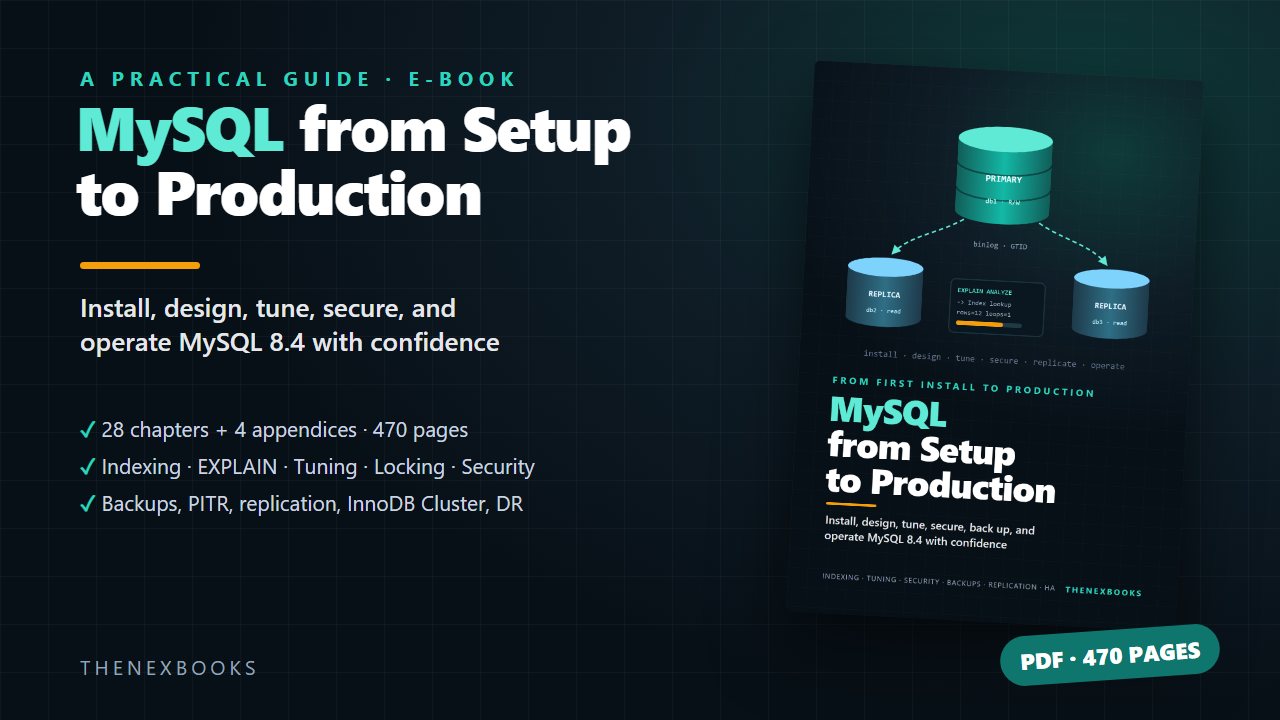
A 471-page, hands-on guide to running MySQL 8.4 in production — from first install to indexing, tuning, security, backups, replication, and high availability.
Install, Design, Tune, Secure, and Operate MySQL 8.4
Read before you buy: the PDF here is a free sample — the first 20 pages of the 471-page book (payments, sales and reviews on this demo site are sample data). Get the full e-book at thenexbooks on Gumroad.
Installing MySQL takes five minutes. Running it in production is a different job.
That job is everything that comes after the install: choosing data types and keys that last, designing indexes that match your queries, reading execution plans, tuning the server without guessing, changing a huge table without downtime, locking down accounts and encryption, taking backups you can actually restore, setting up replication, surviving a failed primary, and upgrading safely.
This book walks the whole path step by step, with one realistic running example: Kettleway, a chain of fitness clubs that grows from three clubs on a single server to forty clubs in two regions — with class bookings, door check-ins, payments, a mobile app, and reports.
- 471 pages · 28 chapters + 4 appendices
- Install MySQL 8.4 LTS on Linux, Windows, macOS, and Docker
- Configuration that is deliberate, not accidental
- How InnoDB works: buffer pool, redo and undo logs, MVCC, crash recovery
- Data types, utf8mb4, schema design, keys, and constraints
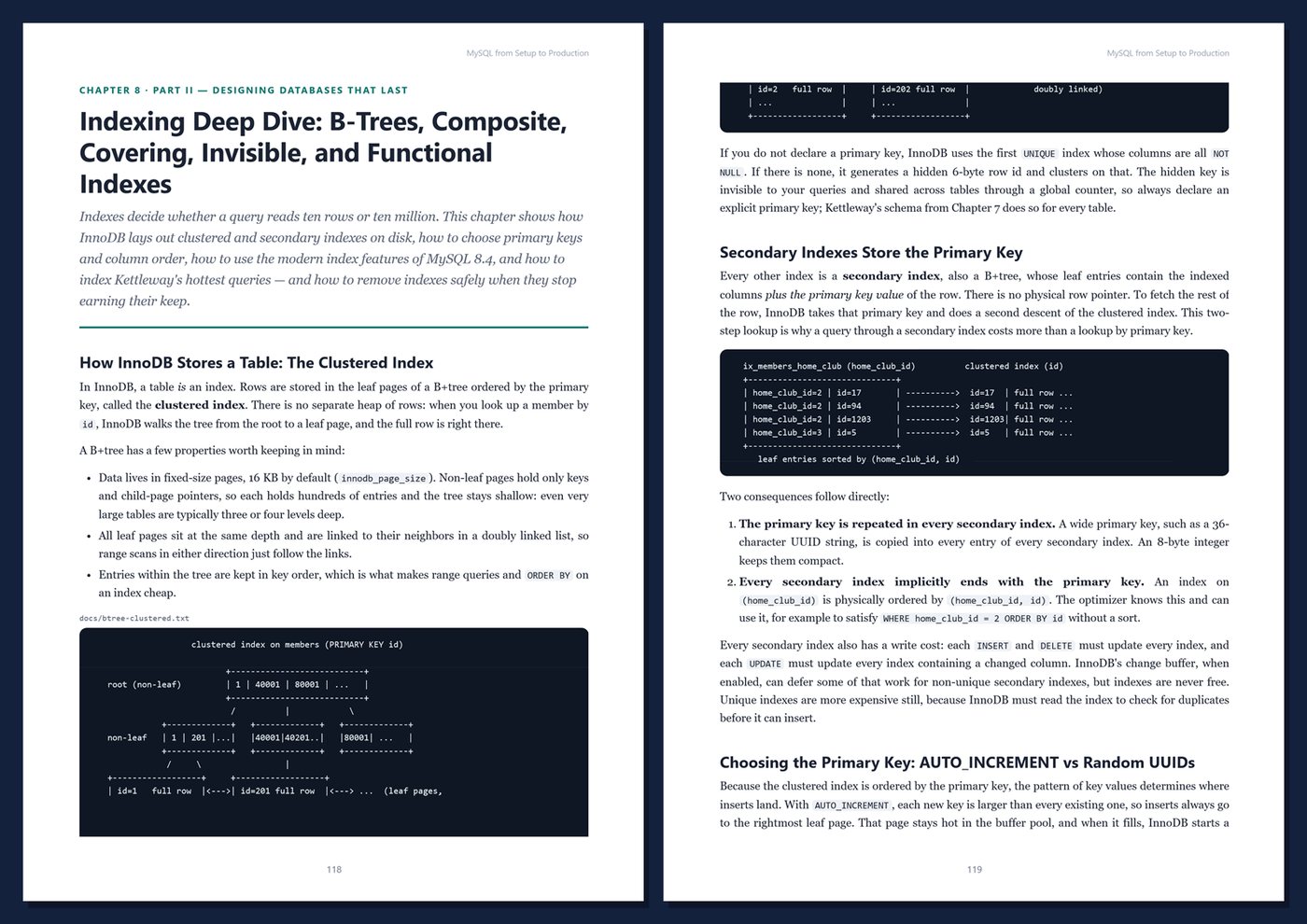
- Indexing deep dive: composite, covering, invisible, and functional indexes
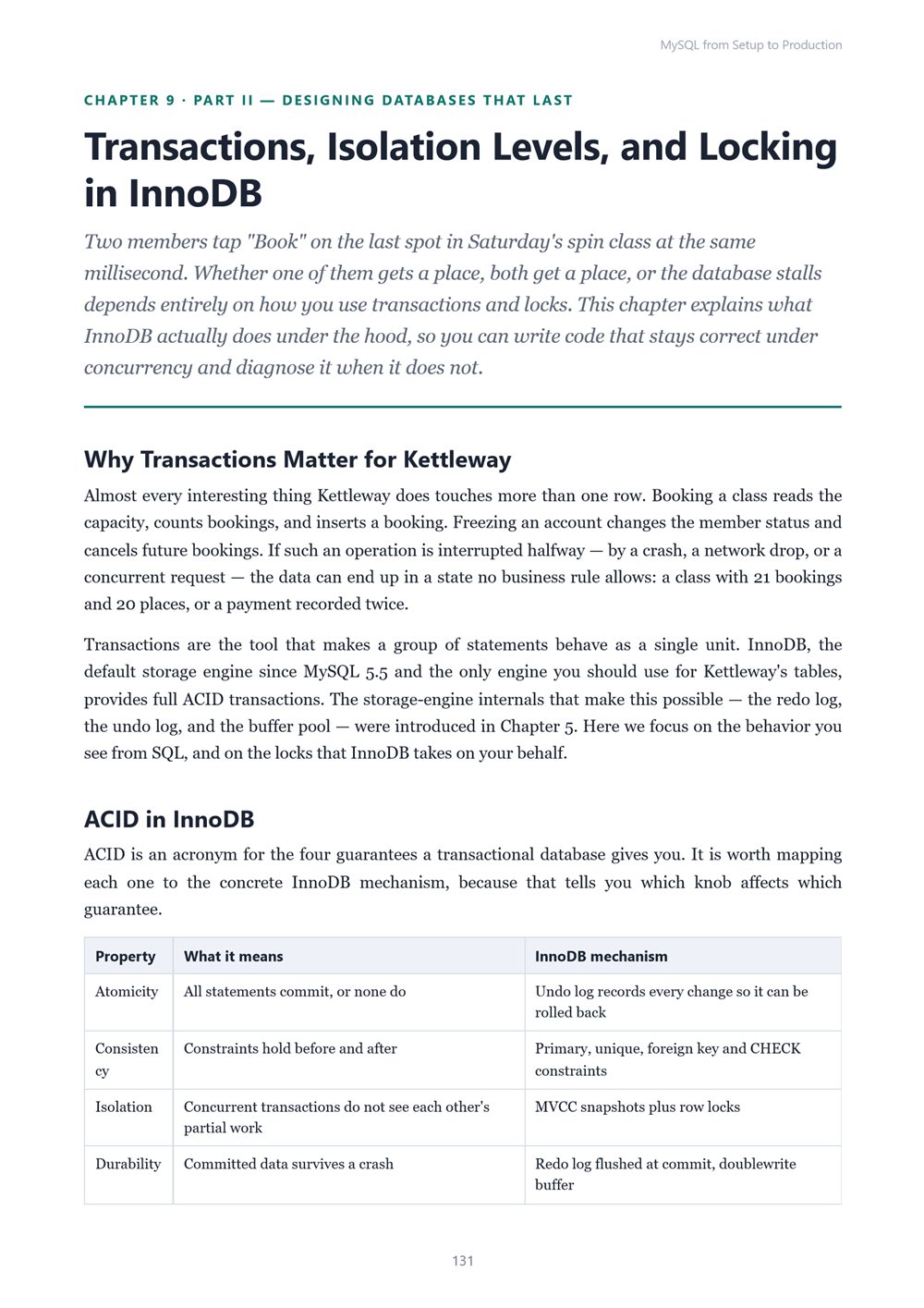
- Transactions, isolation levels, locking, and deadlocks
- JSON, CTEs, window functions, and generated columns
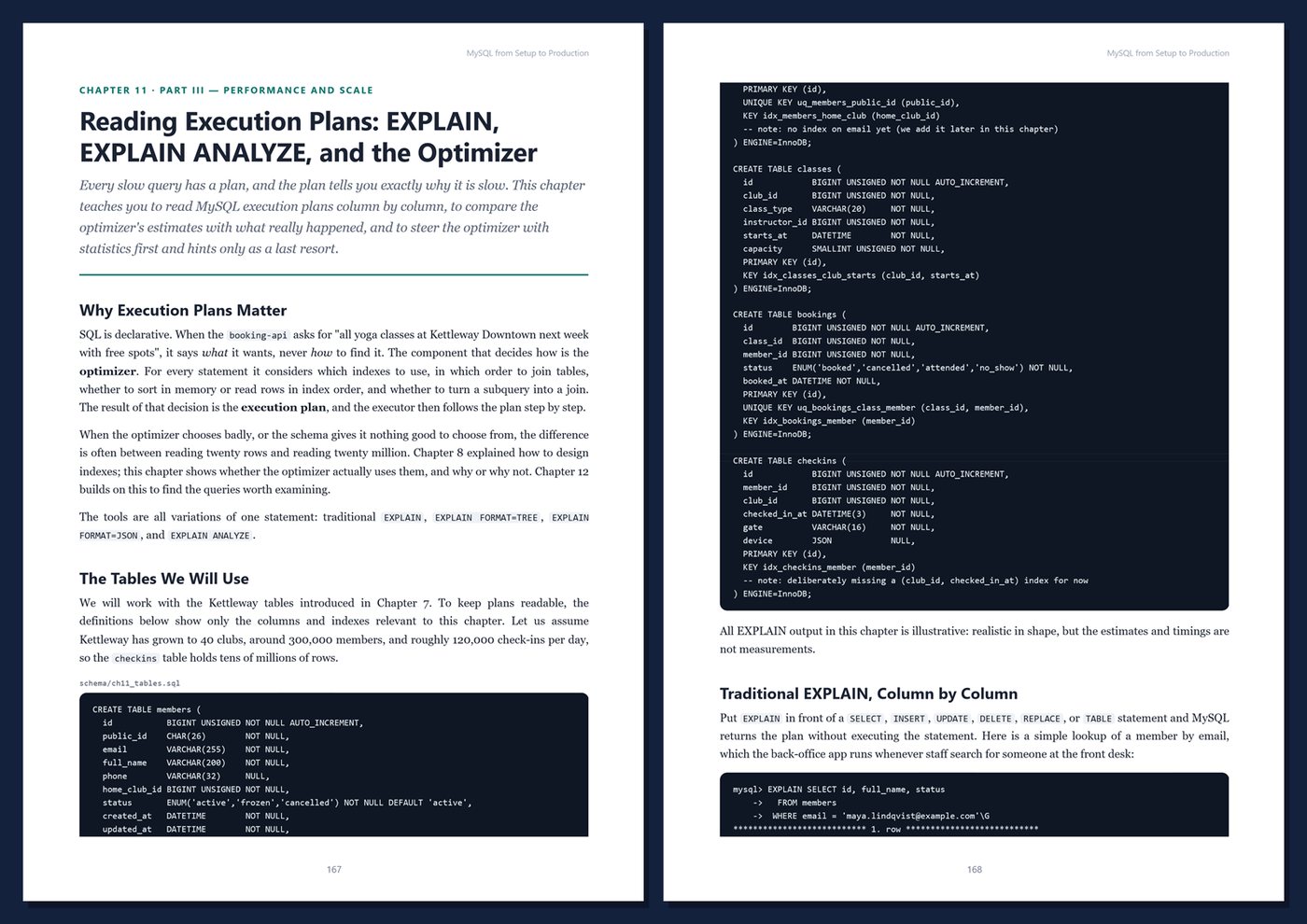
- EXPLAIN, EXPLAIN ANALYZE, slow query log, Performance Schema, and the sys schema
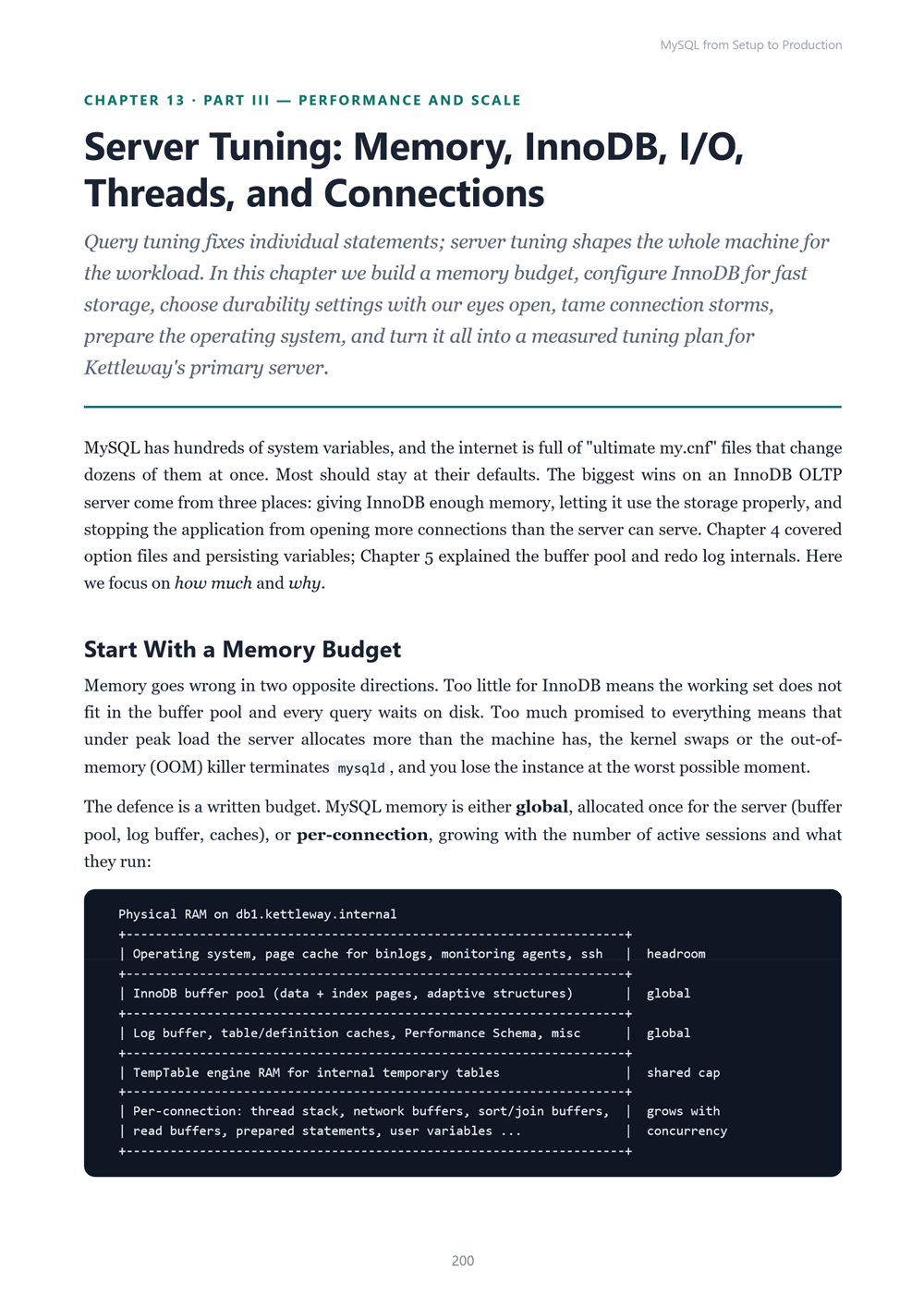
- Server tuning, partitioning, archiving, and online schema changes (gh-ost, pt-osc)
- Accounts, roles, least privilege, TLS, encryption at rest, and hardening
- Drivers, connection pools, ORMs, and migrations with Flyway or Liquibase
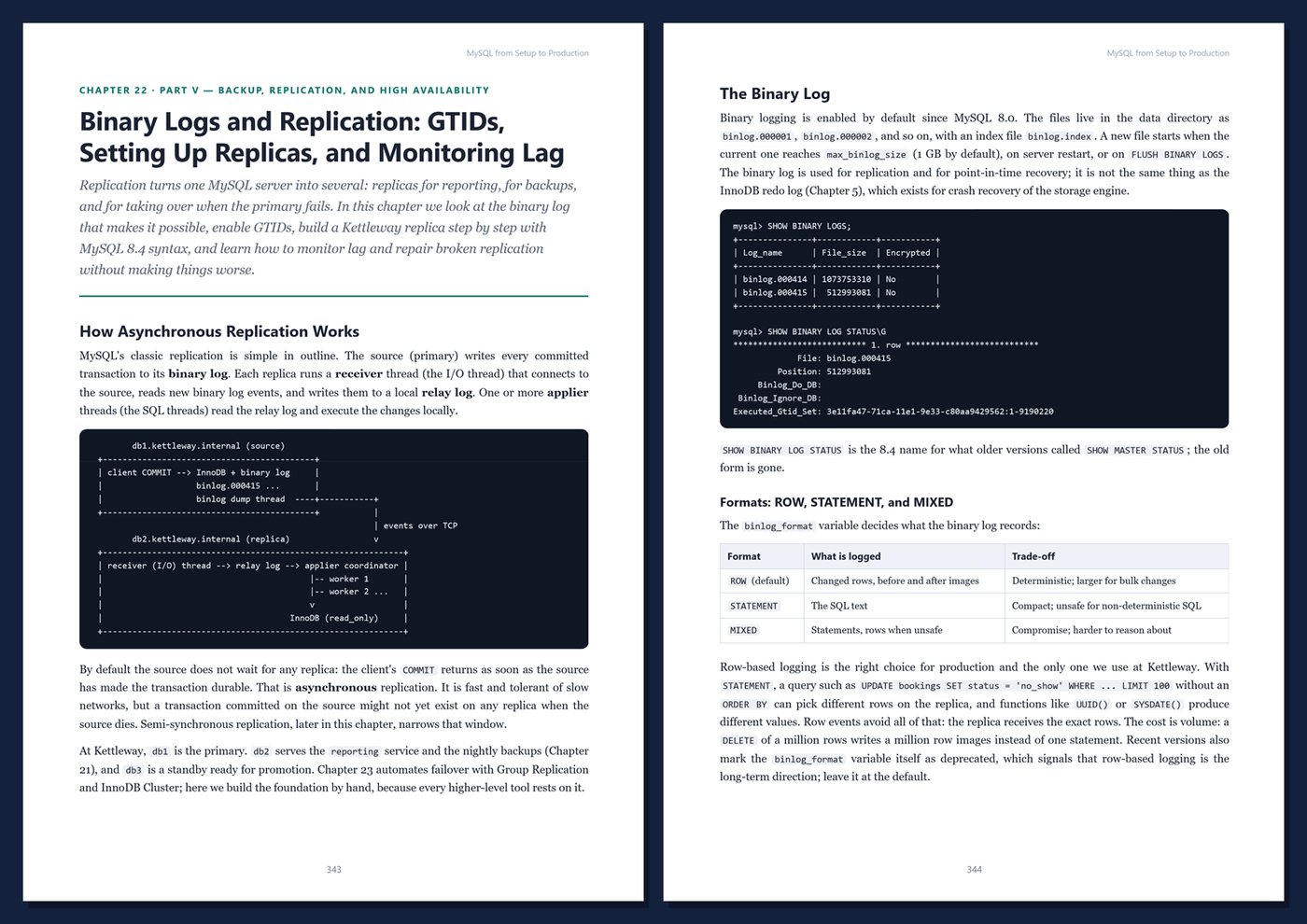
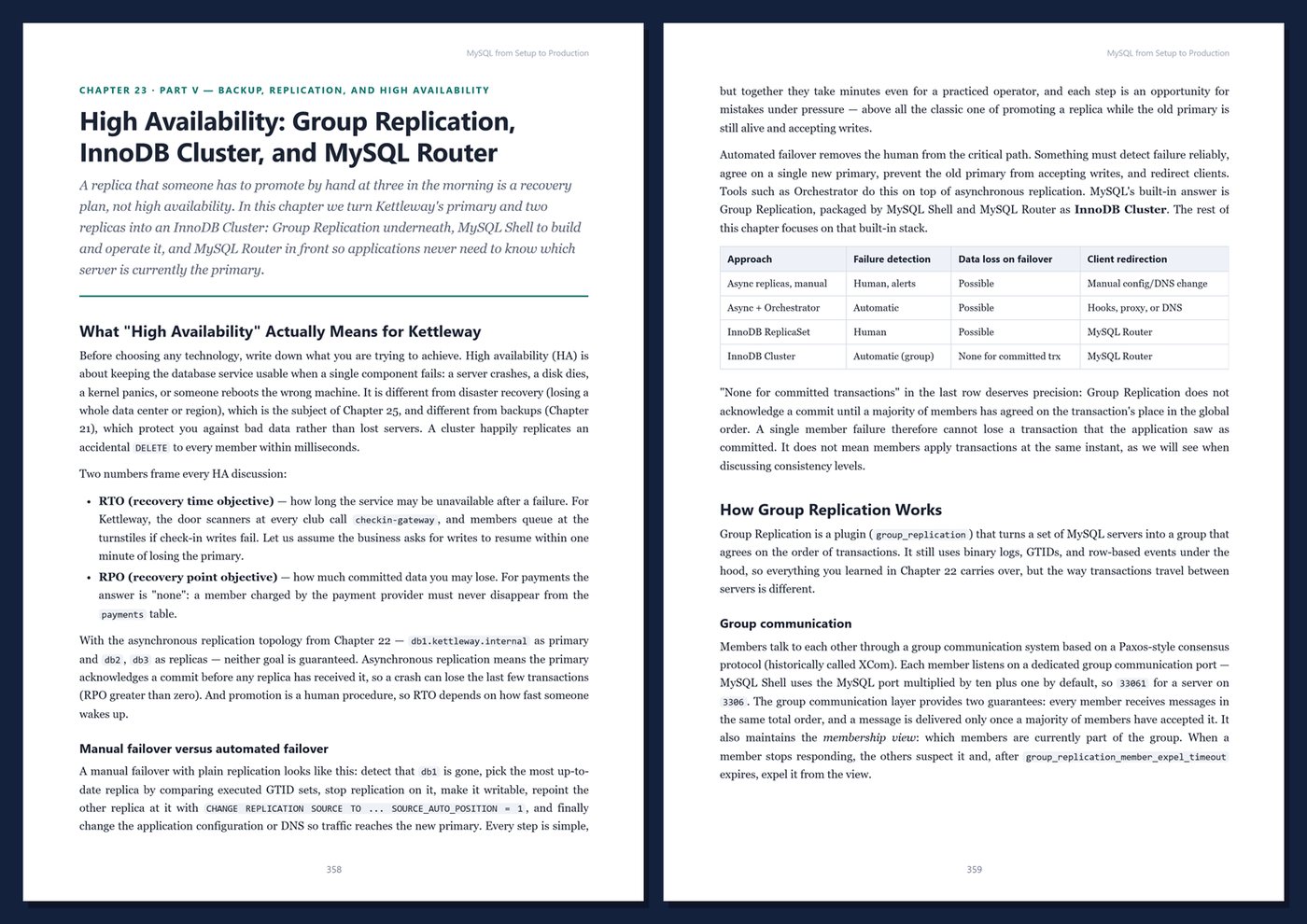
- Backups and point-in-time recovery, GTID replication, InnoDB Cluster, MySQL Router
- Scaling out, disaster recovery, monitoring with Prometheus and Grafana, upgrades, cloud, and Kubernetes
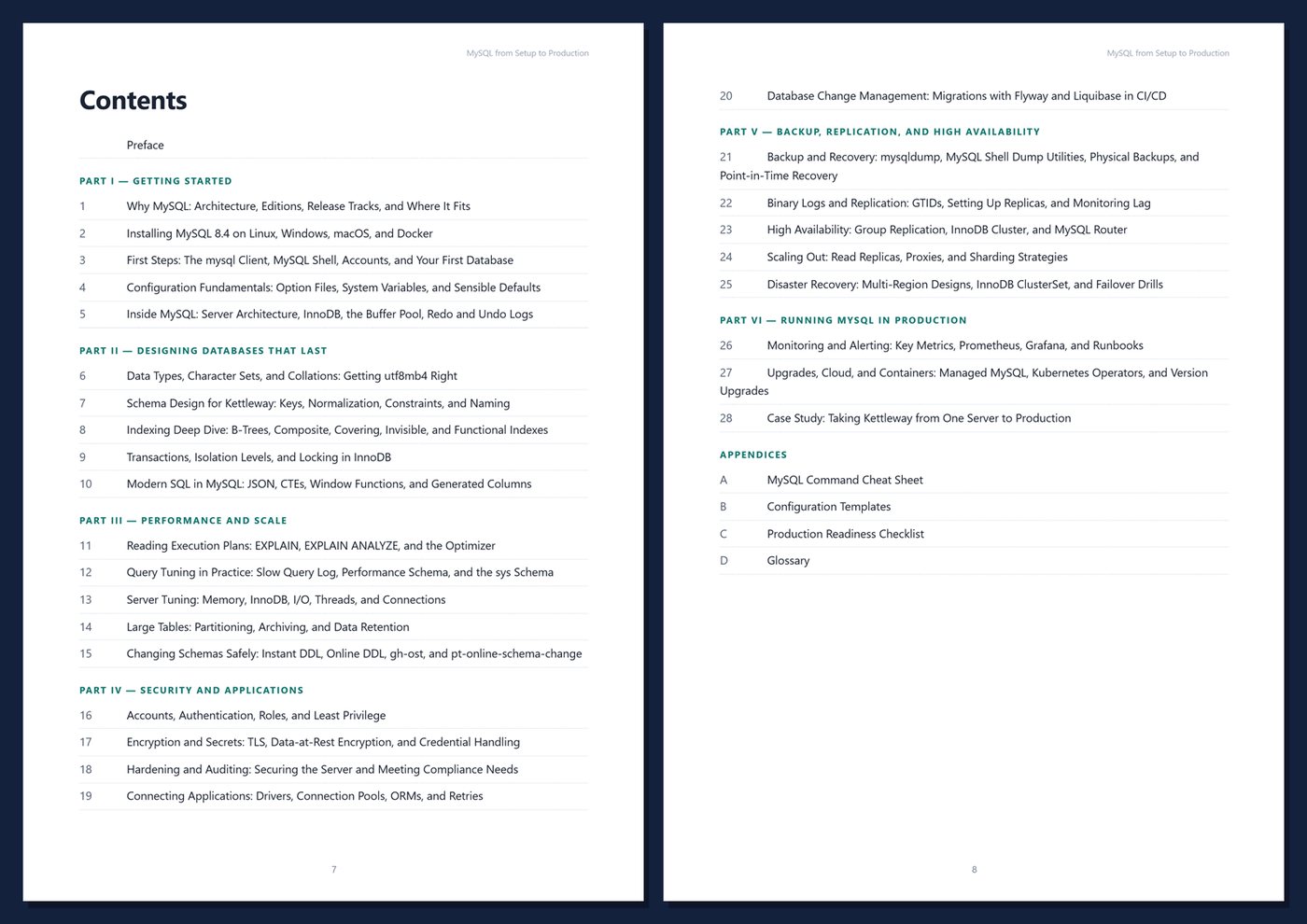
Table Of Contents
Part I — Getting Started
- Ch 1 · Why MySQL: Architecture, Editions, Release Tracks, and Where It Fits
- Ch 2 · Installing MySQL 8.4 on Linux, Windows, macOS, and Docker
- Ch 3 · First Steps: The mysql Client, MySQL Shell, Accounts, and Your First Database
- Ch 4 · Configuration Fundamentals: Option Files, System Variables, and Sensible Defaults
- Ch 5 · Inside MySQL: Server Architecture, InnoDB, the Buffer Pool, Redo and Undo Logs
Part II — Designing Databases That Last
- Ch 6 · Data Types, Character Sets, and Collations: Getting utf8mb4 Right
- Ch 7 · Schema Design for Kettleway: Keys, Normalization, Constraints, and Naming
- Ch 8 · Indexing Deep Dive: B-Trees, Composite, Covering, Invisible, and Functional Indexes
- Ch 9 · Transactions, Isolation Levels, and Locking in InnoDB
- Ch 10 · Modern SQL in MySQL: JSON, CTEs, Window Functions, and Generated Columns
Part III — Performance and Scale
- Ch 11 · Reading Execution Plans: EXPLAIN, EXPLAIN ANALYZE, and the Optimizer
- Ch 12 · Query Tuning in Practice: Slow Query Log, Performance Schema, and the sys Schema
- Ch 13 · Server Tuning: Memory, InnoDB, I/O, Threads, and Connections
- Ch 14 · Large Tables: Partitioning, Archiving, and Data Retention
- Ch 15 · Changing Schemas Safely: Instant DDL, Online DDL, gh-ost, and pt-online-schema-change
Part IV — Security and Applications
- Ch 16 · Accounts, Authentication, Roles, and Least Privilege
- Ch 17 · Encryption and Secrets: TLS, Data-at-Rest Encryption, and Credential Handling
- Ch 18 · Hardening and Auditing: Securing the Server and Meeting Compliance Needs
- Ch 19 · Connecting Applications: Drivers, Connection Pools, ORMs, and Retries
- Ch 20 · Database Change Management: Migrations with Flyway and Liquibase in CI/CD
Part V — Backup, Replication, and High Availability
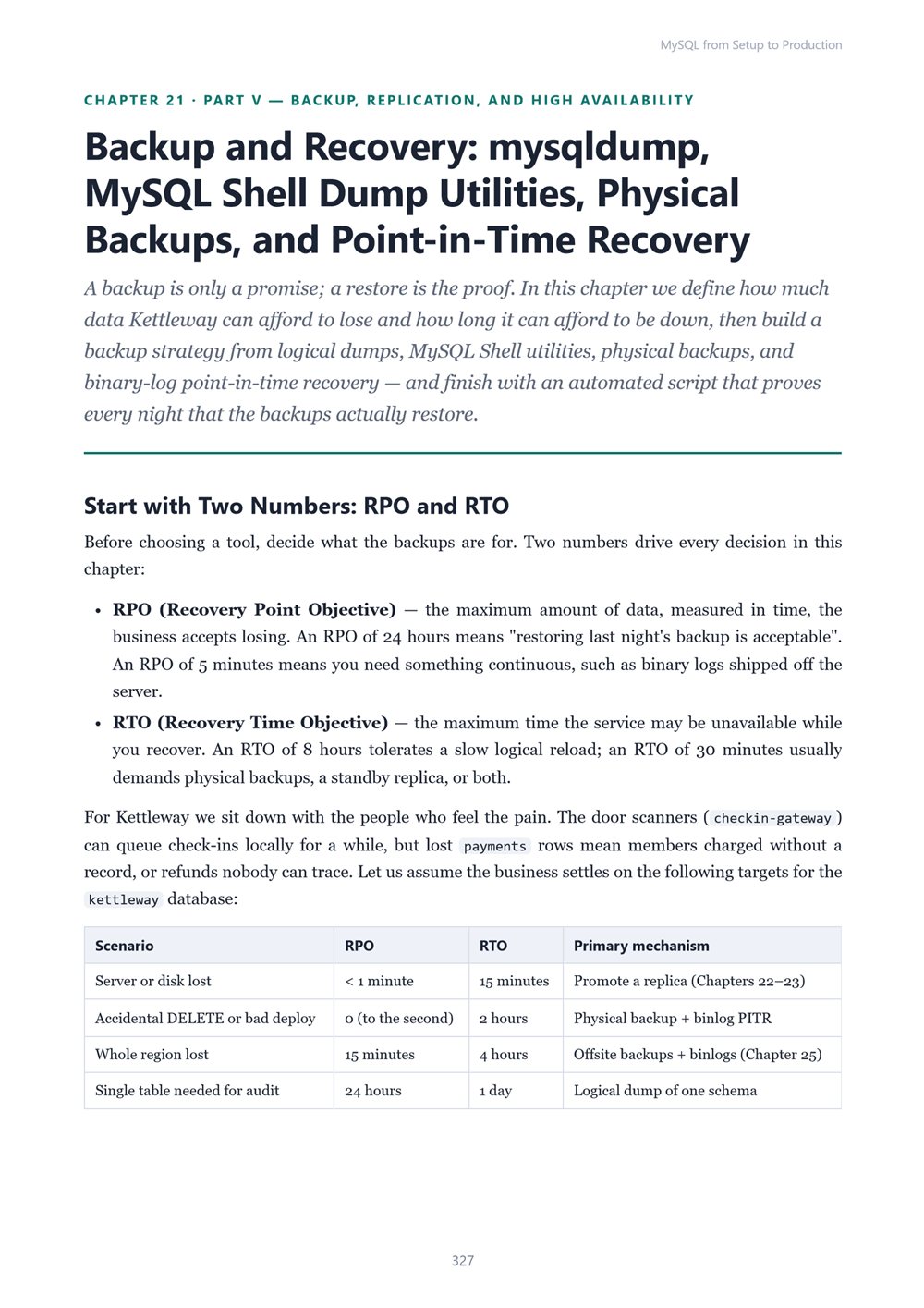
- Ch 21 · Backup and Recovery: mysqldump, MySQL Shell Dump Utilities, Physical Backups, and Point-in-Time Recovery
- Ch 22 · Binary Logs and Replication: GTIDs, Setting Up Replicas, and Monitoring Lag
- Ch 23 · High Availability: Group Replication, InnoDB Cluster, and MySQL Router
- Ch 24 · Scaling Out: Read Replicas, Proxies, and Sharding Strategies
- Ch 25 · Disaster Recovery: Multi-Region Designs, InnoDB ClusterSet, and Failover Drills
Part VI — Running MySQL in Production
- Ch 26 · Monitoring and Alerting: Key Metrics, Prometheus, Grafana, and Runbooks
- Ch 27 · Upgrades, Cloud, and Containers: Managed MySQL, Kubernetes Operators, and Version Upgrades
- Ch 28 · Case Study: Taking Kettleway from One Server to Production
Appendices
- App A · MySQL Command Cheat Sheet
- App B · Configuration Templates
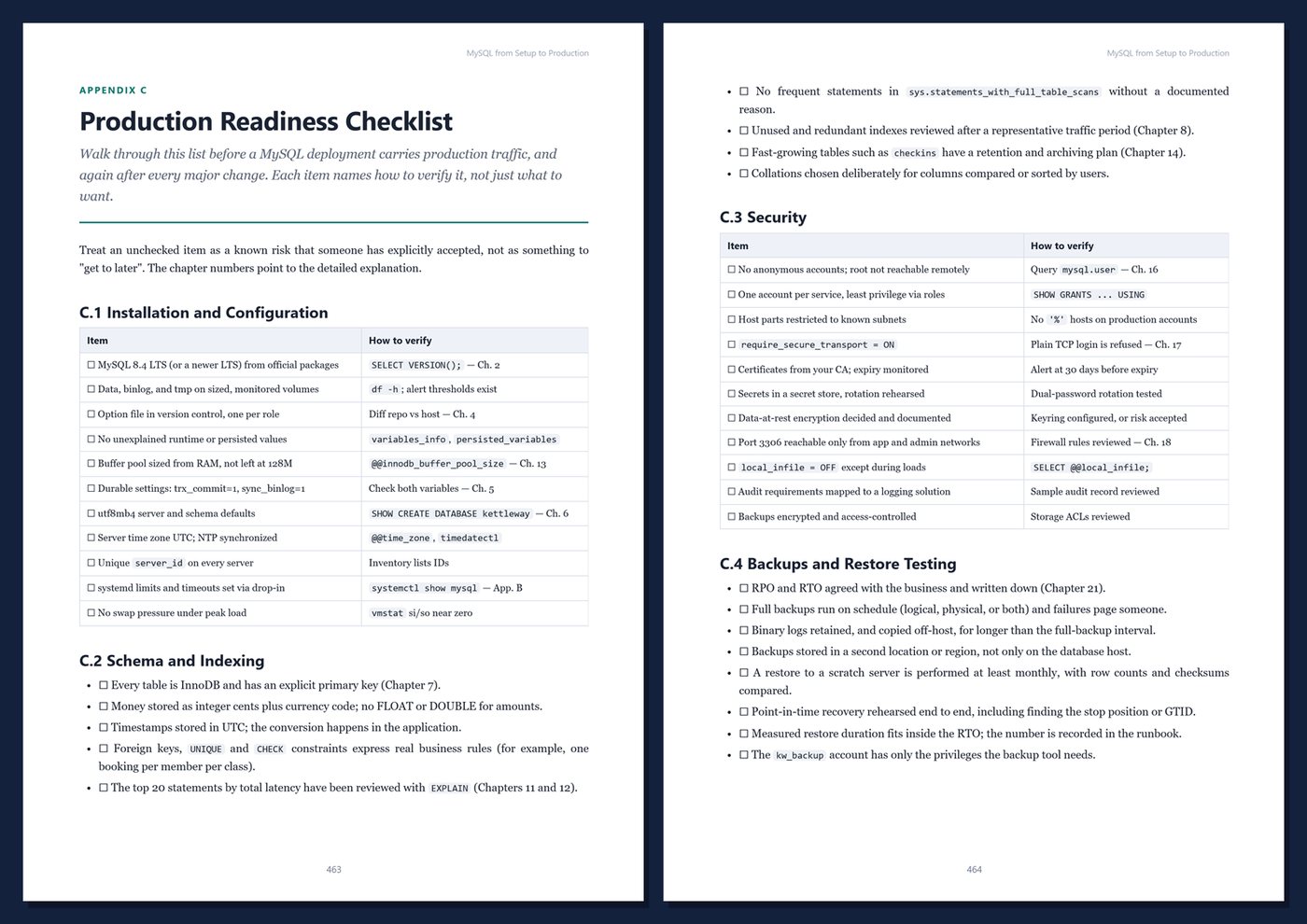
- App C · Production Readiness Checklist
- App D · Glossary
WHO IT IS FOR
Application developers who want to understand what happens below their ORM, DevOps and platform engineers who run MySQL servers, aspiring DBAs who want a structured path from first install to production operations, and tech leads choosing between self-managed MySQL, managed cloud services, and Kubernetes. You need basic SQL and the Linux command line — no prior DBA experience.
FORMAT
PDF (A4), 471 pages, English, clickable table of contents and PDF bookmarks. 1st Edition, 2026. Published by thenexbooks.
This book is independent and is not affiliated with or endorsed by Oracle Corporation or any other company. MySQL is a registered trademark of Oracle and/or its affiliates. Kettleway and all examples are fictional.
Book details
| Detail | |
|---|---|
| Pages | 471 |
| Format | PDF (A4) |
| Language | English |
| Level | Beginner to Advanced |
| Edition | 1st Edition, 2026 |
| Download on this site | Free sample, first 20 pages (PDF) |
| Publisher | thenexbooks |
Files you get
No reviews yet. Only buyers can review.
More from thenexbooks