 1 / 11
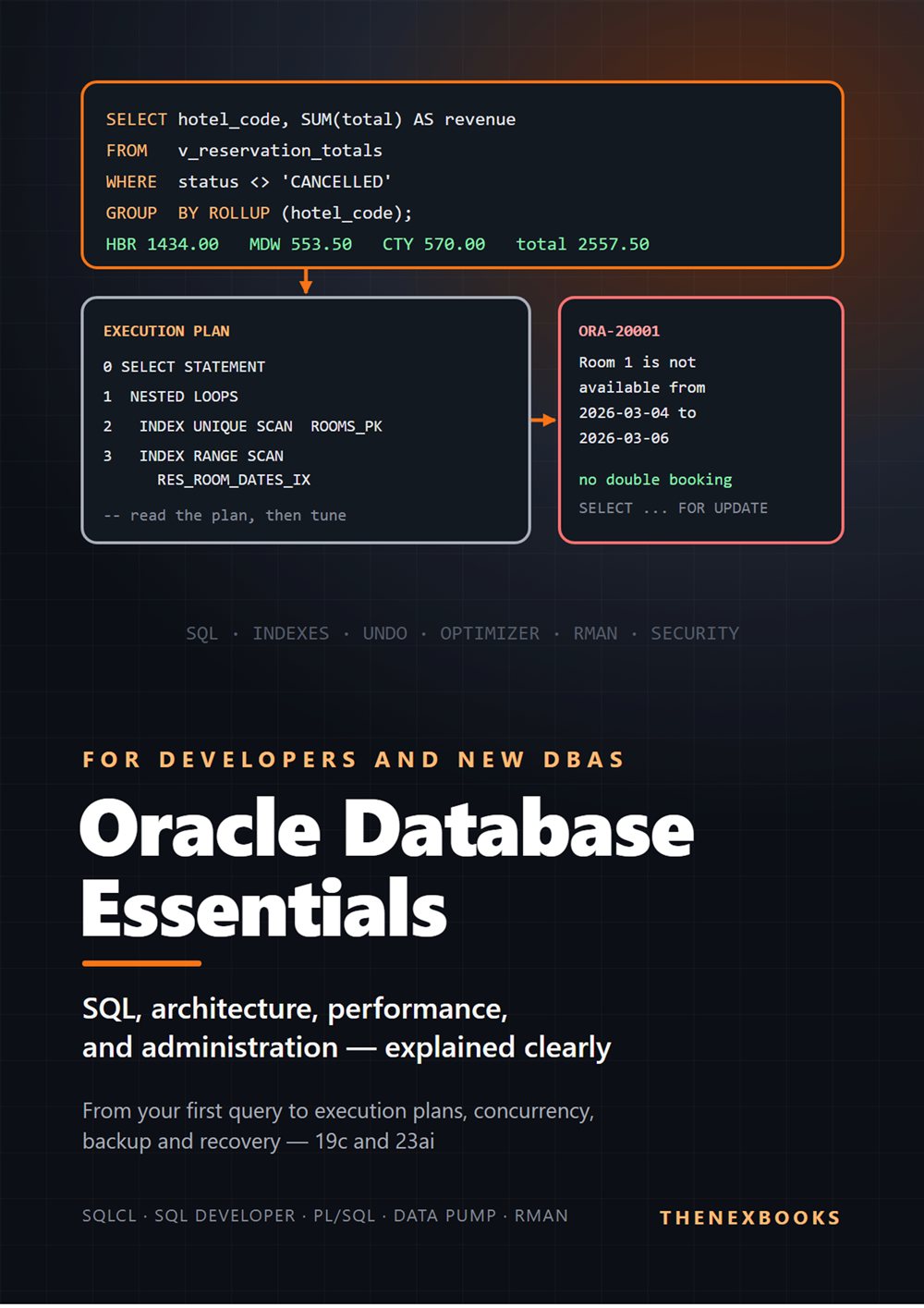
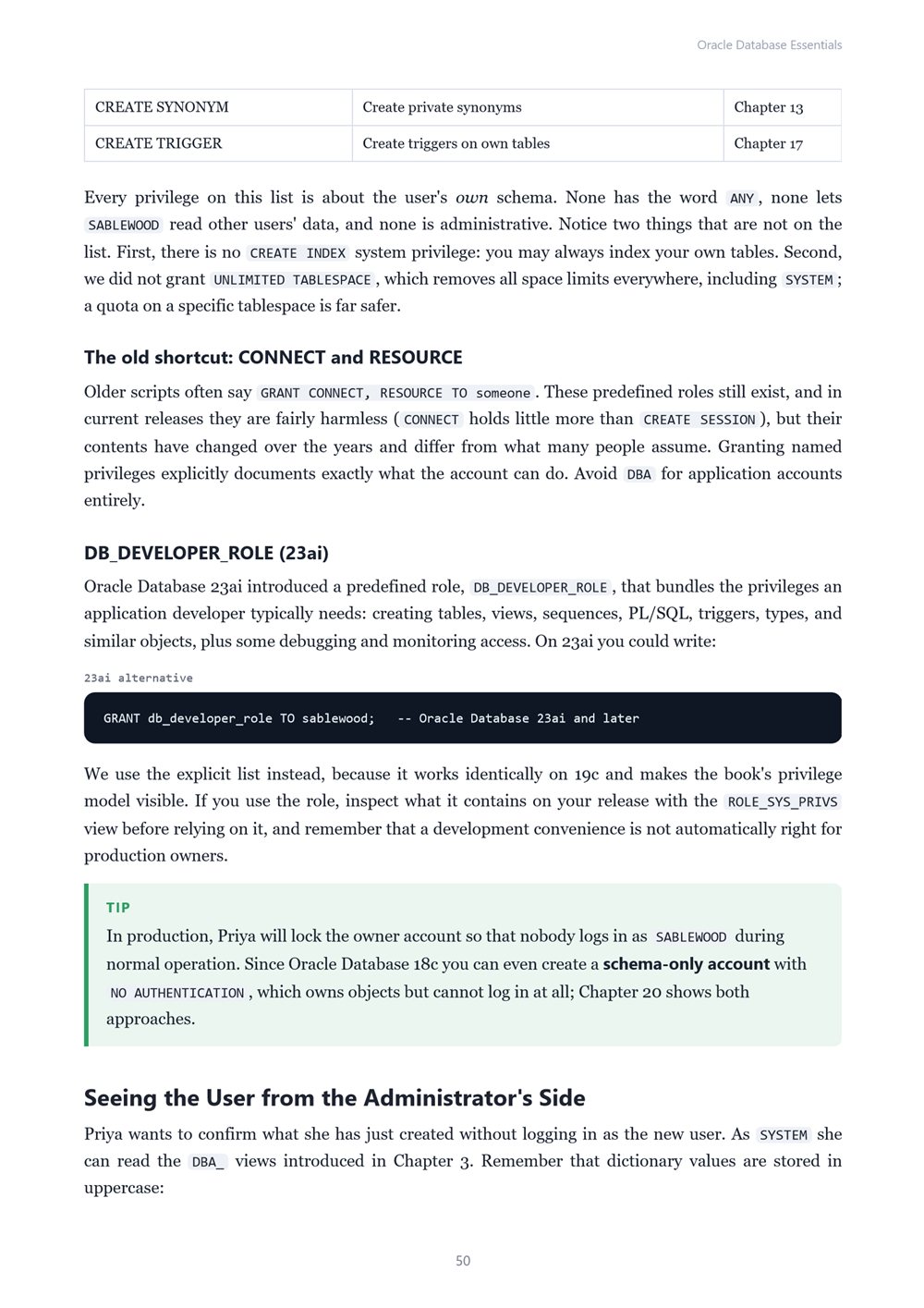
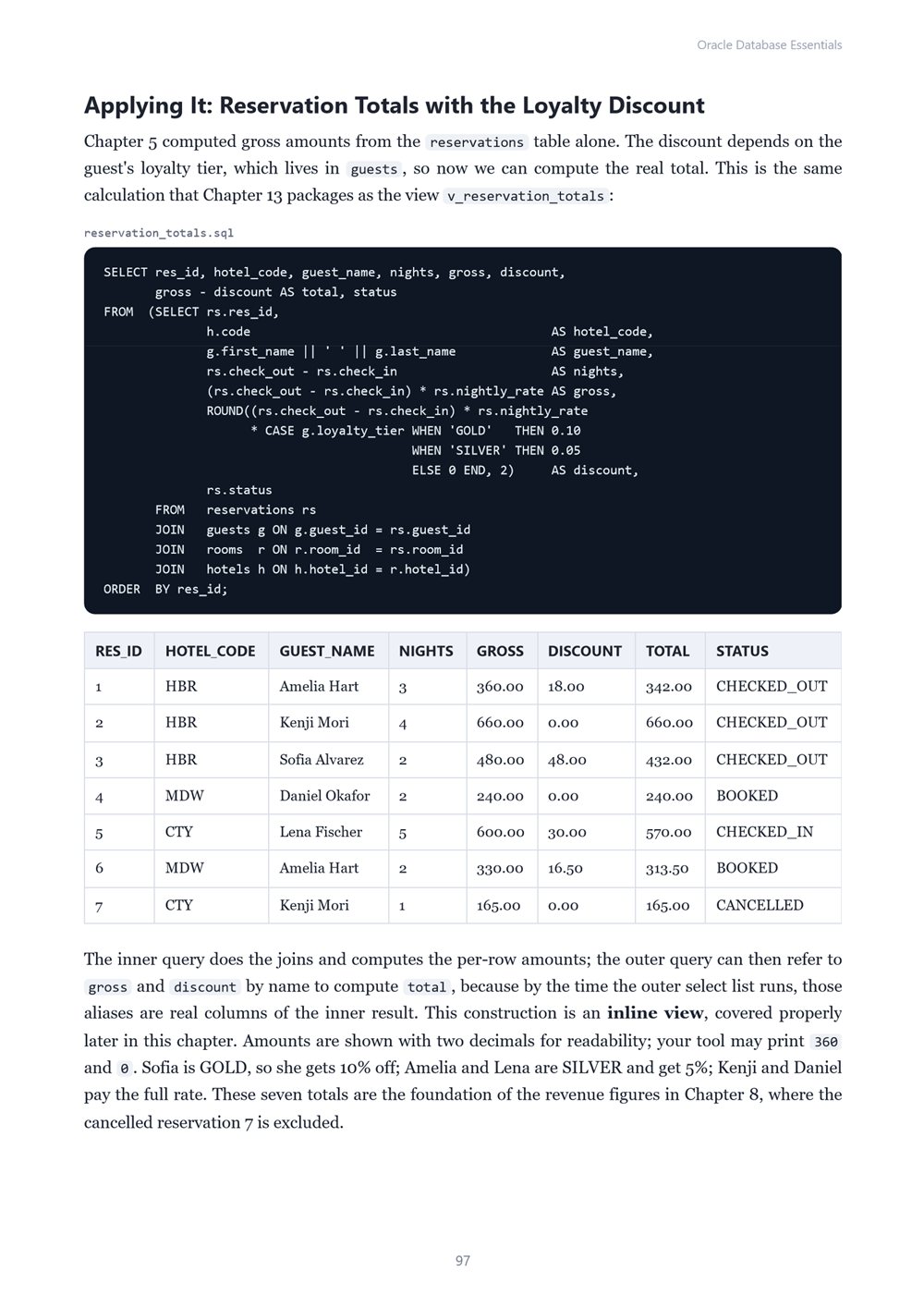
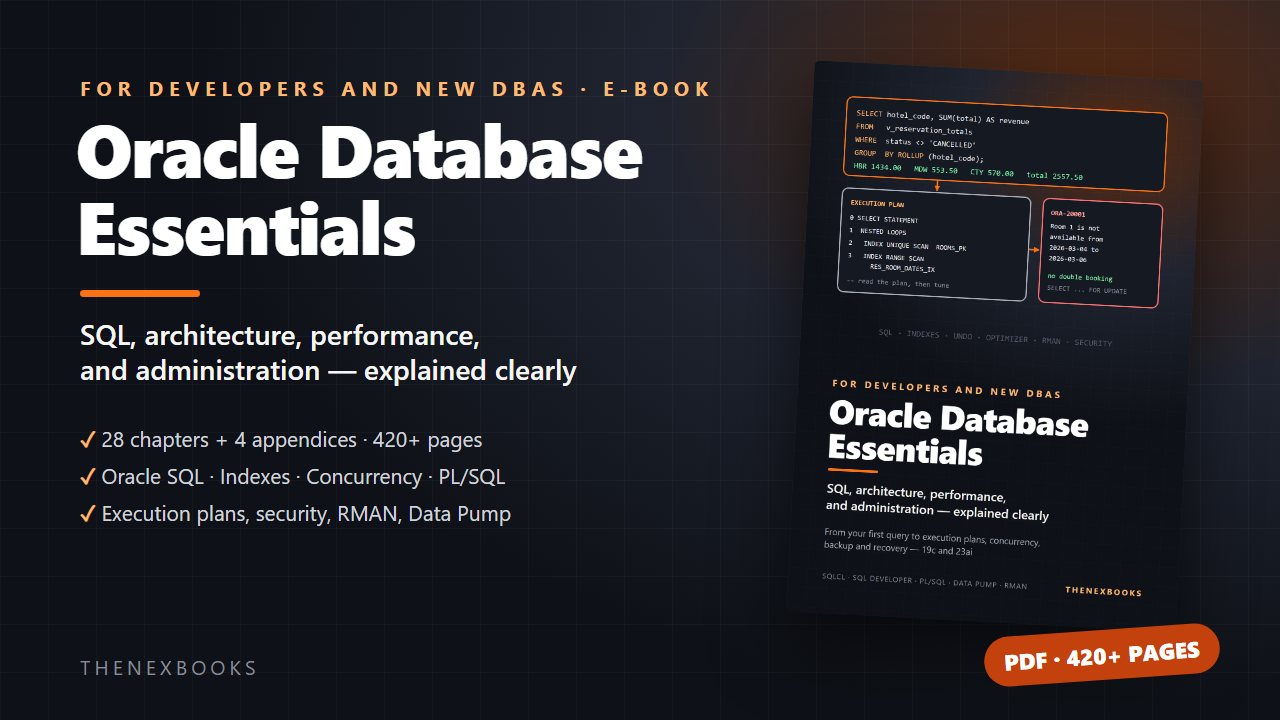
A 426-page, practical guide to Oracle Database for developers and new DBAs — installing Oracle Database Free, architecture, Oracle SQL from basics to analytic functions, schema design and indexes, concurrency, PL/SQL essentials, 23ai features, security, execution plans and tuning, monitoring, and…
SQL, Architecture, Performance, and Administration for Developers and New DBAs
Read before you buy: the PDF here is a free sample — the first 20 pages of the 426-page book (payments, sales and reviews on this demo site are sample data). Get the full e-book at thenexbooks on Gumroad.
Oracle Database runs a huge share of the world's business systems. Sooner or later, many developers find themselves connected to one — and many teams discover that someone has to look after it. This book gives you the foundation to do both with confidence.
We start by running the free edition of Oracle Database in a container and connecting with SQL Developer and SQLcl. Then we learn how an Oracle database is put together — instances, CDBs and PDBs, memory, processes, and files — and write Oracle SQL from simple queries to analytic functions, hierarchical queries, PIVOT, and MERGE. We design tables, constraints, indexes, views, materialized views, and partitions, and study how Oracle keeps every query consistent while others change the same rows. We write just enough PL/SQL to enforce real business rules, use JSON and the newest 23ai SQL features, connect applications safely from Java, Python, and Node.js, and secure the database with least privilege. Finally we learn how the optimizer works, read execution plans, tune slow queries, monitor a busy database, and manage storage, backups, and recovery.
Throughout the book you build and run the database for Sablewood Hotels, a fictional group of three hotels: rooms, guests, reservations, and payments — protected from double bookings, tuned, secured, and backed up.
- 426 pages · 28 chapters + 4 appendices · practice exercises in every chapter
- Oracle Database Free in a container, SQL Developer, SQLcl, and SQL*Plus
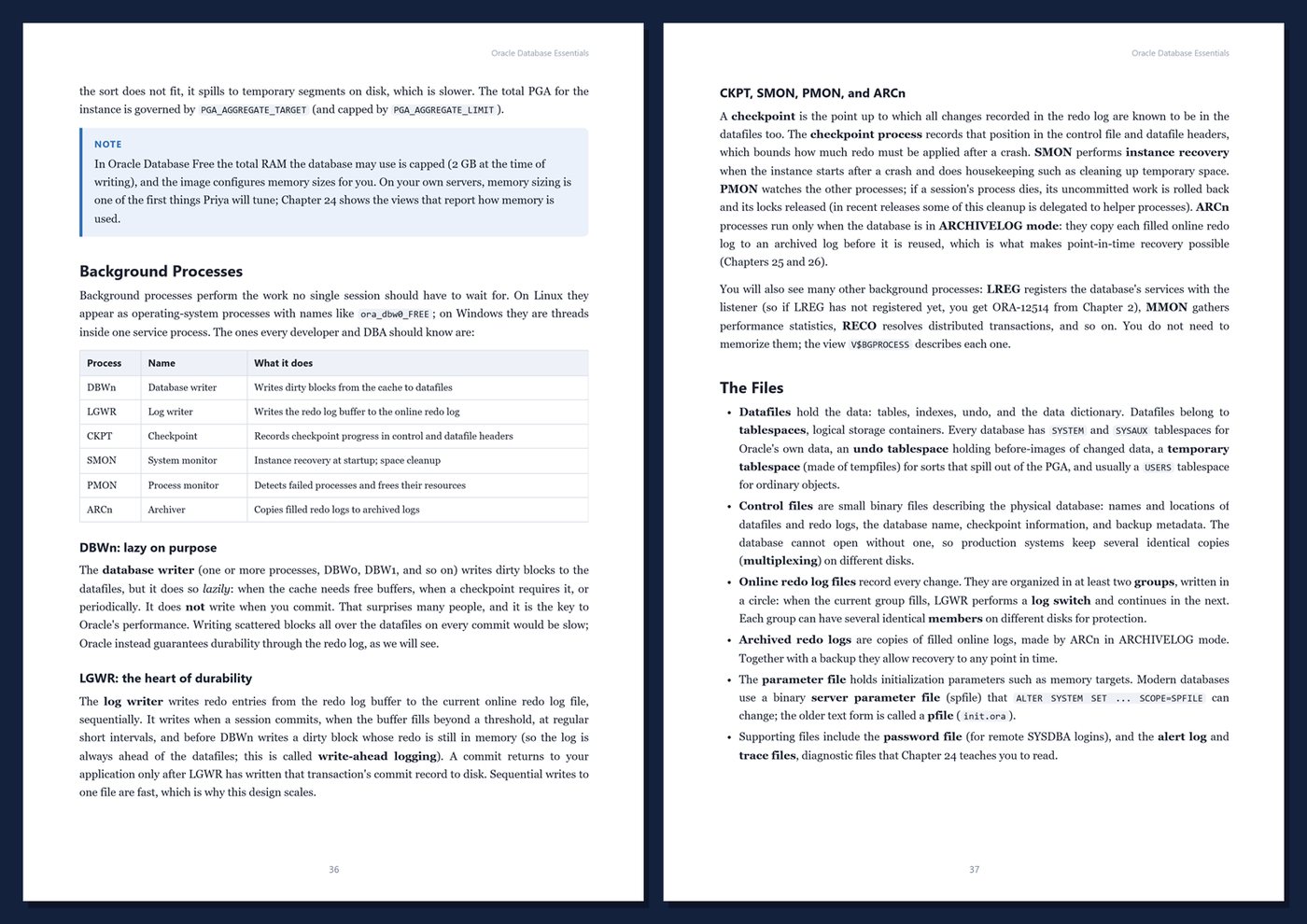
- Oracle architecture explained for developers: instance, CDB/PDB, SGA, PGA, redo, undo
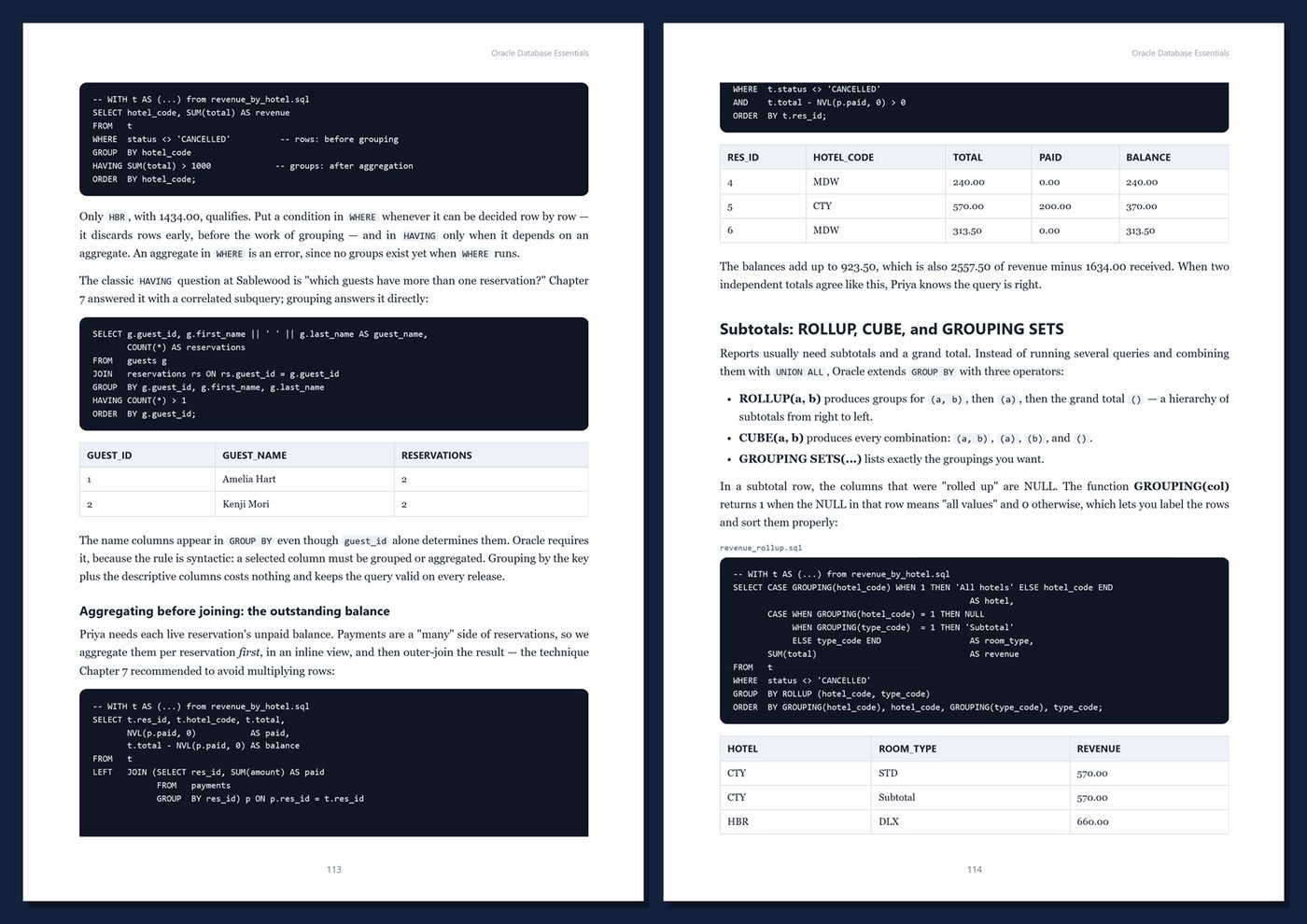
- Oracle SQL: functions, data types, joins, subqueries, aggregation, analytic functions, CTEs, PIVOT, MERGE
- Constraints, identity columns, B-tree/bitmap/function-based indexes, views, materialized views, partitioning
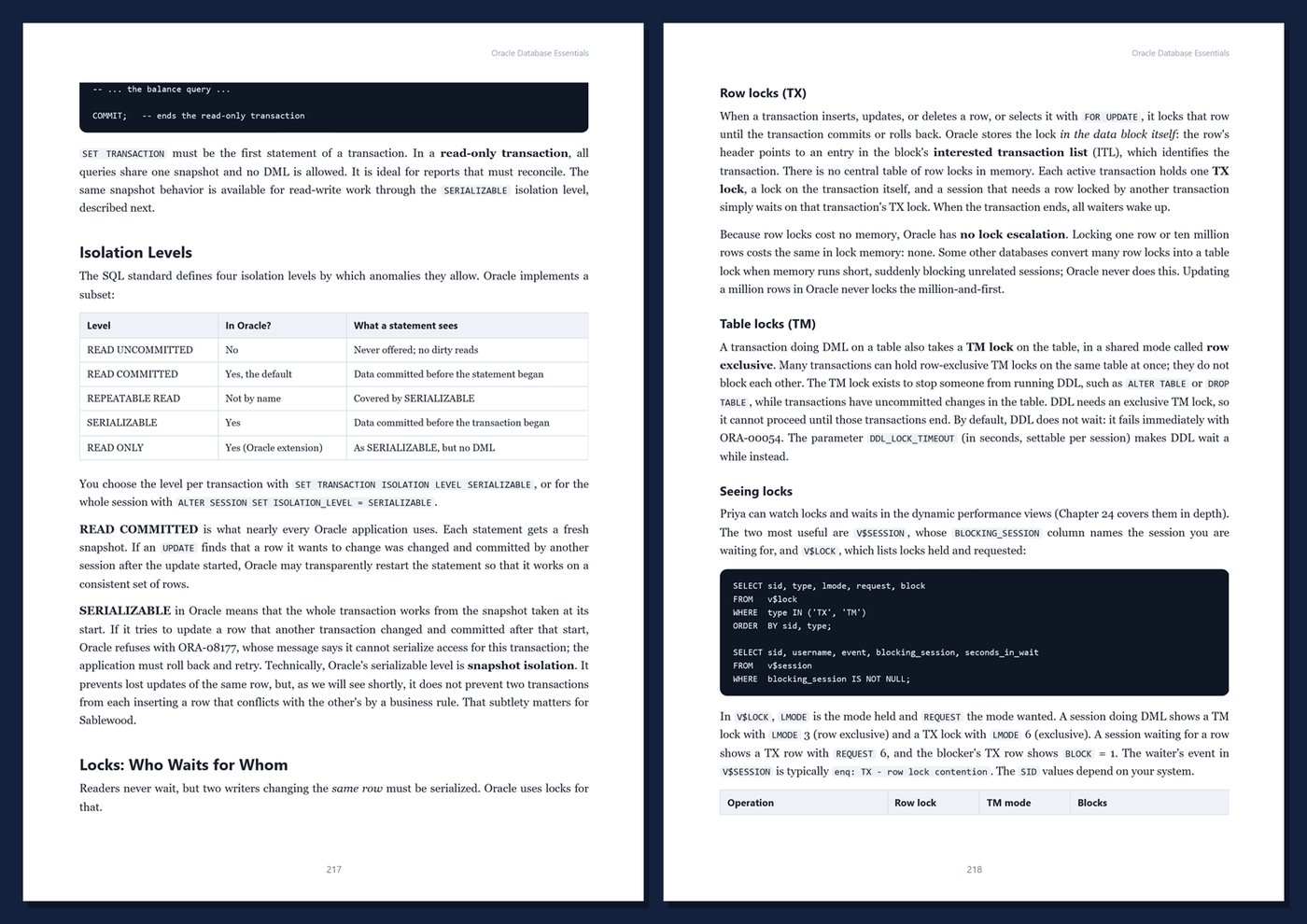
- Concurrency and read consistency: undo, locks, isolation levels, SELECT … FOR UPDATE
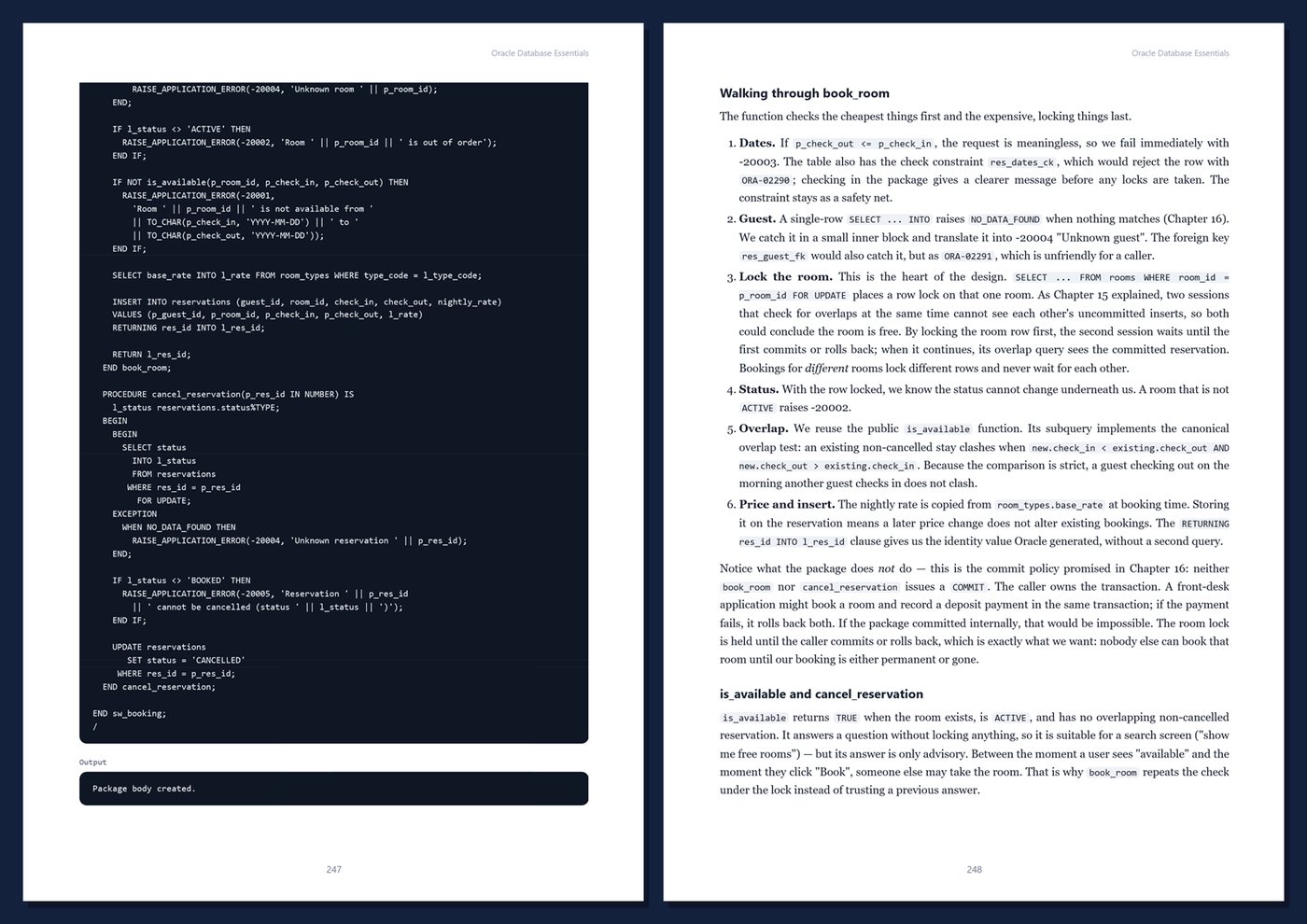
- PL/SQL essentials, packages, and triggers — a real booking package with no double bookings
- JSON and Oracle Database 23ai features: JSON type, duality views, BOOLEAN, SQL domains, and more
- Connecting applications with JDBC, python-oracledb, and node-oracledb using bind variables and pools
- Security: users, roles, privileges, and least privilege
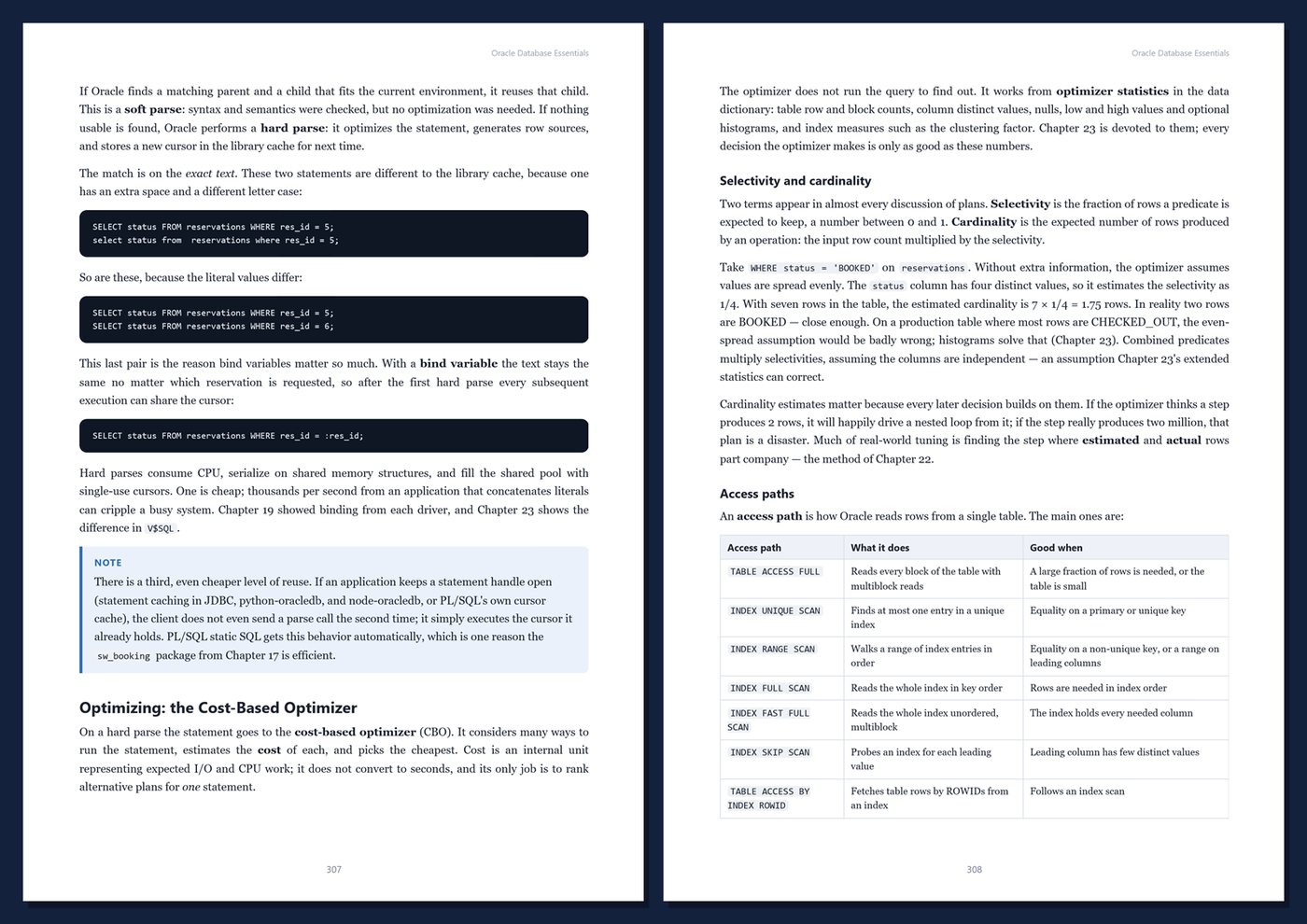
- The optimizer, execution plans, query tuning, statistics, and monitoring with V$ views
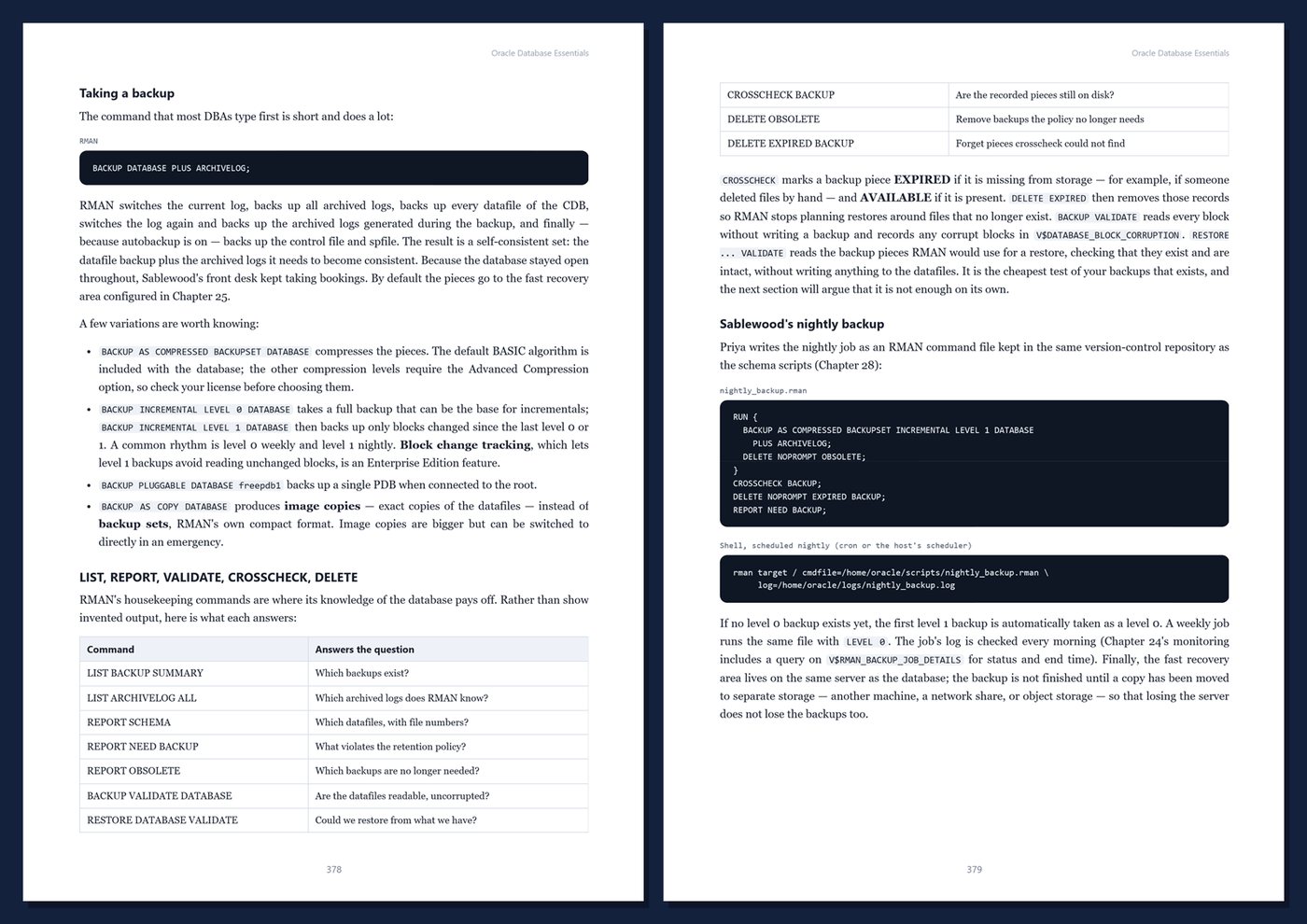
- Tablespaces and redo, RMAN backups, Data Pump, Flashback, and an overview of Data Guard, RAC, and Autonomous Database
- Licensing cautions where features need extra-cost options or packs
- Covers Oracle Database 19c and later, with 23ai features clearly marked
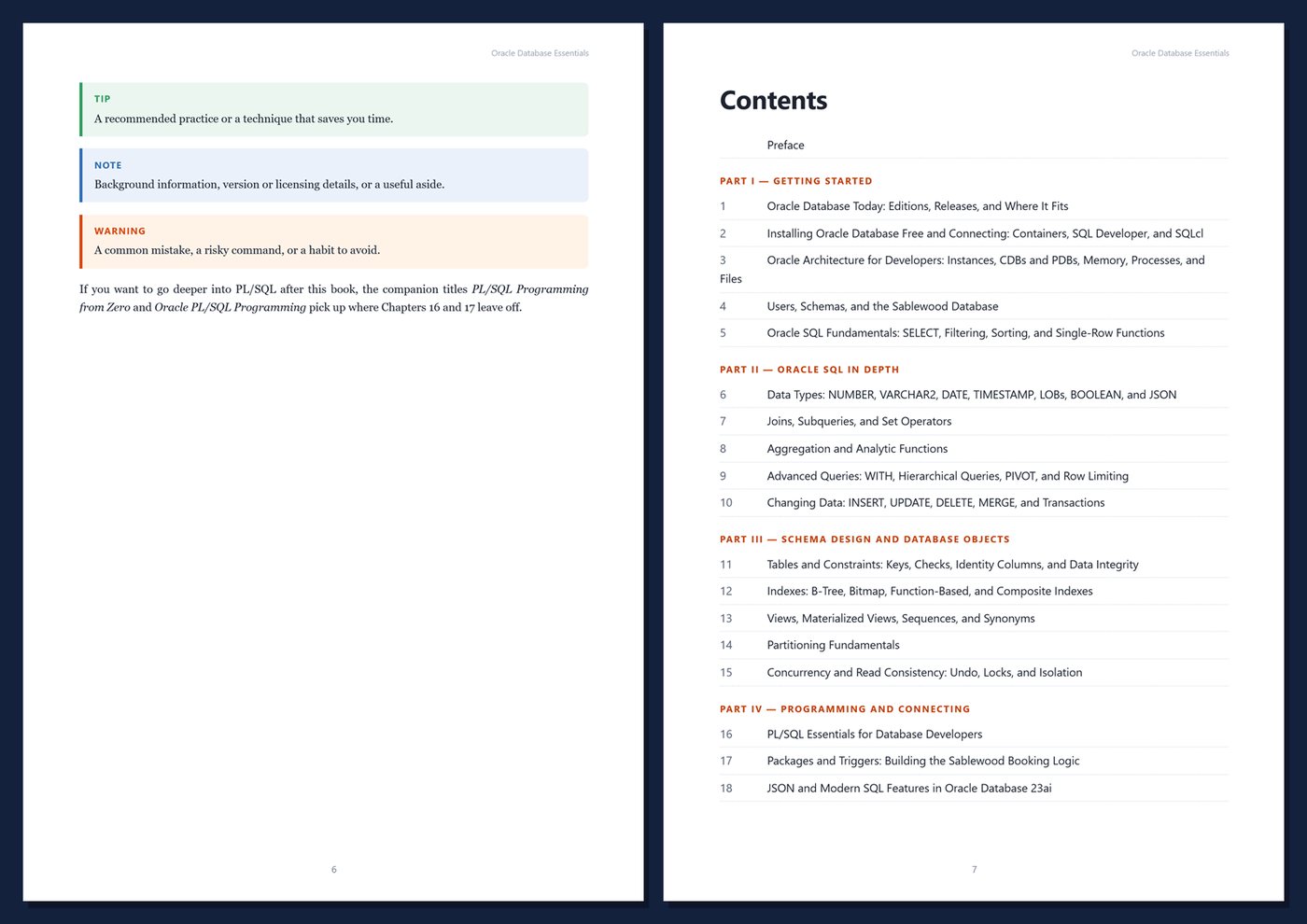
Table Of Contents
Part I — Getting Started
- Ch 1 · Oracle Database Today: Editions, Releases, and Where It Fits
- Ch 2 · Installing Oracle Database Free and Connecting: Containers, SQL Developer, and SQLcl
- Ch 3 · Oracle Architecture for Developers: Instances, CDBs and PDBs, Memory, Processes, and Files
- Ch 4 · Users, Schemas, and the Sablewood Database
- Ch 5 · Oracle SQL Fundamentals: SELECT, Filtering, Sorting, and Single-Row Functions
Part II — Oracle SQL in Depth
- Ch 6 · Data Types: NUMBER, VARCHAR2, DATE, TIMESTAMP, LOBs, BOOLEAN, and JSON
- Ch 7 · Joins, Subqueries, and Set Operators
- Ch 8 · Aggregation and Analytic Functions
- Ch 9 · Advanced Queries: WITH, Hierarchical Queries, PIVOT, and Row Limiting
- Ch 10 · Changing Data: INSERT, UPDATE, DELETE, MERGE, and Transactions
Part III — Schema Design and Database Objects
- Ch 11 · Tables and Constraints: Keys, Checks, Identity Columns, and Data Integrity
- Ch 12 · Indexes: B-Tree, Bitmap, Function-Based, and Composite Indexes
- Ch 13 · Views, Materialized Views, Sequences, and Synonyms
- Ch 14 · Partitioning Fundamentals
- Ch 15 · Concurrency and Read Consistency: Undo, Locks, and Isolation
Part IV — Programming and Connecting
- Ch 16 · PL/SQL Essentials for Database Developers
- Ch 17 · Packages and Triggers: Building the Sablewood Booking Logic
- Ch 18 · JSON and Modern SQL Features in Oracle Database 23ai
- Ch 19 · Connecting Applications: Java, Python, and Node.js with Bind Variables and Connection Pools
- Ch 20 · Security: Users, Roles, Privileges, and Least Privilege
Part V — Performance
- Ch 21 · How Oracle Executes SQL: Parsing, the Optimizer, and Execution Plans
- Ch 22 · Reading Execution Plans and Tuning Queries
- Ch 23 · Optimizer Statistics, Bind Variables, and Cursor Sharing
- Ch 24 · Monitoring and Diagnostics: Dynamic Performance Views, the Alert Log, and AWR
Part VI — Operations and Next Steps
- Ch 25 · Storage Management: Tablespaces, Datafiles, Redo, and Archiving
- Ch 26 · Backup and Recovery: RMAN, Data Pump, and Flashback
- Ch 27 · High Availability and the Cloud: Data Guard, RAC, and Autonomous Database in Overview
- Ch 28 · Project: Running Sablewood End to End — A Production Checklist and Where to Go Next
Appendices
- App A · Oracle SQL Cheat Sheet
- App B · Data Dictionary and V$ Views Quick Reference
- App C · ORA- Error Field Guide
- App D · Glossary
WHO IT IS FOR
Application developers who work with Oracle; developers and DBAs moving from PostgreSQL, MySQL, or SQL Server; new and "accidental" DBAs who need a solid foundation; and students in database courses. Want to go deeper into PL/SQL? The companion titles "PL/SQL Programming from Zero" and "Oracle PL/SQL Programming" pick up where this book leaves off.
FORMAT
PDF (A4), 426 pages, English, clickable table of contents and PDF bookmarks. 1st Edition, 2026. Published by thenexbooks.
This book is independent and is not affiliated with, sponsored by, or endorsed by Oracle Corporation. Oracle, Java, and MySQL are registered trademarks of Oracle and/or its affiliates.
Book details
| Detail | |
|---|---|
| Pages | 426 |
| Format | PDF (A4) |
| Language | English |
| Level | Beginner to Intermediate |
| Edition | 1st Edition, 2026 |
| Download on this site | Free sample, first 20 pages (PDF) |
| Publisher | thenexbooks |
Files you get
No reviews yet. Only buyers can review.
More from thenexbooks